

Call Center Quality Management: Act on QA Results
Use call center quality management to connect QA scores, fair team reviews and corrective actions. Get a practical checklist for owners, deadlines and review.

Este artículo está actualmente disponible solo en inglés.Ver en inglés →
A supervisor can finish a quality review with a score for every agent and still have no answer to a practical question: who will fix the recurring refund mistake before the next shift?
Call center quality management connects the evaluation of customer interactions to decisions about people, workflows and follow-up. Managers check the evidence behind a score, decide what needs to change, assign responsibility and verify the change. A dashboard supplies part of that evidence. It does not assign responsibility by itself.
This guide covers the management decisions that follow a QA review. For criteria, weights and interaction-level scoring, start with our customer service quality assurance guide.
What call center quality management should decide
Separate three decisions: whether an interaction met its requirements, how to assess an agent over a review period, and what the business must change. They can draw on the same conversation, but they need different records and different owners.
| Decision | Evidence to examine | What the decision produces |
|---|---|---|
| Did this interaction meet the rubric? | Conversation, applicable policy and scorecard version | A reviewed score, including any critical error |
| How should this period’s performance be assessed? | Eligible interactions, work mix, agreed performance rules and disputed results | An explained period review |
| What should change in the operation? | Repeated issue, root cause, affected process and responsible team | An assigned corrective action with a verification date |
Consider a hypothetical returns team. An agent approves a refund outside their authority. The interaction needs a review against the refund rule. The agent’s period assessment needs the agreed eligibility rules and any relevant context. The underlying process might also need a change if the knowledge base displays an obsolete approval limit.
Assigning all three questions to “agent coaching” would leave the obsolete instruction available to the next person. Equally, changing the knowledge article would not explain whether the original score was correct. Keep the records connected so a later reviewer can follow both decisions.
The distinction also helps managers set the agenda for a meeting. A calibration meeting resolves how reviewers apply a criterion. A performance discussion considers an agent’s work over an agreed period. A corrective-action review checks whether someone completed and verified a specific change. Combining those meetings is possible, but the minutes should still show which decision was made.
ISO’s quality management principles include evidence-based decision making and improvement. (ISO, n.d.) Those principles support keeping an explainable record of a management decision. They do not supply a call-center bonus formula or a universal passing score.
Check eligibility before comparing performance
Agree which conditions must be satisfied before a performance total can qualify for the decision being made. Then review the evidence for any failed condition. A high productivity score should not silently cancel a confirmed violation of an agreed critical rule.
In Callnovo.ai’s English-team management practice, the review considers minimum quality and attendance requirements alongside output and resolution. Serious behavior such as an unauthorized refund or a deliberate hang-up can act as a disqualifying condition under the agreed assessment rules. The operational concern is whether the agent resolves work properly without transferring avoidable work or cost to someone else.
That practice requires clear definitions. “Critical error” needs to identify the behavior, the applicable policy and the evidence needed to confirm it. If the rule is “refund outside authority,” reviewers need the authority limit that applied at the time and the action the agent actually took. A customer asking for an excessive refund is not proof that the agent granted it.
Before completing a period review, check:
- Which conditions affect eligibility, and when were they communicated?
- Does each flagged result have a conversation or system record behind it?
- Was the rule applicable to this task, language and agent role?
- Has a reviewer considered disputed context or an incorrect automated classification?
- Can the agent see the explanation and use the agreed review process?
The passing levels and consequences belong in the organization’s approved performance process. Set them before using the results for decisions about an individual. Avoid changing a threshold after seeing who passed it.
Call center quality assurance metrics also need denominators. If one report covers all scored contacts and another covers only completed tickets, they describe different populations. Record the time window, unit of work, exclusions and rubric version beside the result. A “not applicable” criterion should have a defined treatment rather than silently becoming either a pass or a failure.
Work mix needs similar care. An agent handling complex returns may receive more escalations than someone answering delivery-status questions. Compare similar work where possible, and show the remaining differences. When the relevant sample is small, examine the underlying cases before using the percentage to rank people.
COPC’s quality management course treats critical errors, sampling, calibration and analysis with action as distinct topics. (COPC, n.d.) The distinction is useful when setting up a review: collecting more scores does not resolve a disagreement about what a criterion means.
Assign a fix and define the closing evidence
A corrective action needs an owner, a deadline and evidence that the intended change happened. “Discussed with the team” records an activity. It does not show whether the original problem has stopped occurring.
Callnovo.ai’s operational reporting framework tracks the issue, supporting evidence, cause, responsible person, deadline, verifier and closure evidence. The following action plan template adapts those fields for a quality meeting. It is a working format a team can adopt, not a claim that a particular customer has already achieved an improvement.
| Field | What to write | Illustrative refund example |
|---|---|---|
| Issue and evidence | The observable failure and a retrievable record | A reviewed interaction used the old approval limit |
| Cause to investigate | What may have produced the failure | An old knowledge article remained available |
| Action and owner | The specific change and the person responsible | Knowledge owner replaces the article and archives the old version |
| Due date | When the action should be ready for review | The date agreed in the meeting |
| Verifier | Who checks that the action did what was intended | A supervisor who can review the article and subsequent work |
| Closure evidence | What must be available before closing the item | Correct article available to agents; applicable later interactions use the current limit |
| Reopen condition | What sends the issue back for investigation | The retired instruction appears in another interaction |
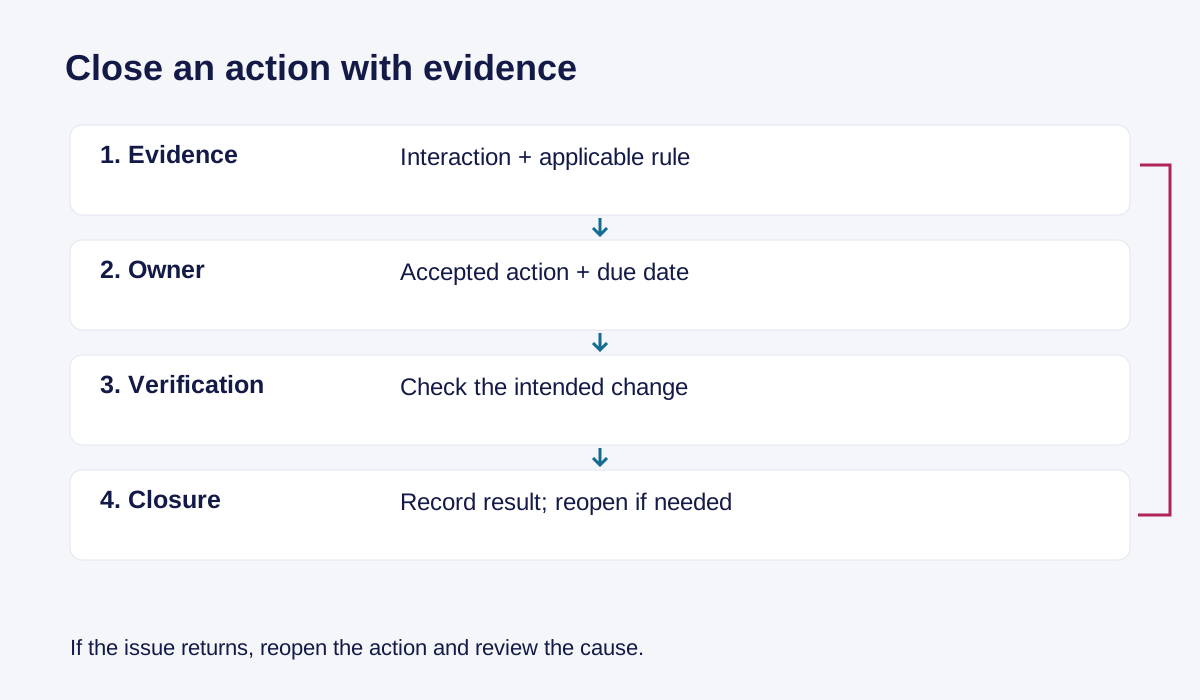
Start by confirming the issue. Keep a direct reference to the interaction and the policy version, with access restricted to the people who need to review them. If evidence is missing, record that gap rather than writing an unverified cause as a fact.
Next, separate a capability gap from a process gap. Someone may understand the policy but lack permission to carry out the required action. Another agent may have the correct access but misunderstand the boundary. The first situation needs an access or escalation change; the second may need coaching and a knowledge check. Some cases need both.
Make the owner specific enough that the work can be accepted. “Operations” is too broad if nobody in operations has agreed to change the workflow. The owner should acknowledge the action and its due date. If another team must provide an input, name that dependency in the record.
Choose the verification method while assigning the action. For a knowledge correction, check that the correct version is accessible in the agent’s normal workflow. For a training action, use a relevant practice task and review subsequent applicable work. For a routing correction, test the affected route and inspect the resulting assignment. The check should match the cause being addressed.
Do not close the action solely because the deadline arrived. Record whether verification passed, failed or could not yet be completed. If no relevant customer interactions occurred during the follow-up window, say that the operational outcome remains unobserved. The preparatory change may be complete while the result still needs checking.
For a manager deciding how to improve call center quality, the next steps are specific: identify the behavior or process that needs to change, give someone the means to change it, and examine evidence afterward. It also gives the next supervisor a usable record when the original owner is away.
Use reports to test the decision
Reports should let a manager move from an aggregate result to the work that explains it. Keep language, channel, task type and review period visible, then investigate a difference before treating it as an individual performance problem.
In an anonymous South American last-mile logistics project, Callnovo.ai organized Spanish and Portuguese work using language and intent routing. Reporting could be examined by language, skill group, time period and issue type. That project illustrates how to organize a review around the work being handled; it does not establish a universal performance gain from splitting a dashboard.
A bilingual queue can contain different tasks and customer expectations. If one language receives mostly delivery-status questions and the other receives delivery exceptions, a blended average can obscure that difference. Preserve enough context to explain the comparison, while keeping small groups from being treated as statistically reliable rankings.
When evaluating call center quality assurance software, ask to retrieve a score together with its evidence and the rubric that produced it. In Callnovo.ai’s HeroScore AI quality assurance offering, the scoring inputs include the knowledge base, business rules, prompt instructions and deduction criteria. Confirm which inputs and channels apply to the proposed setup, and test disputed or inapplicable items during the demonstration.
For an outsourced review function, agree the evidence, reviewer responsibilities and follow-up scope through our quality assurance service. Callnovo.ai provides human support in 65+ languages; confirm the reviewer language and task expertise required for each project.
For training follow-up, HeroCoach connects learning work with practice and assessment. The implemented training chain includes courses, knowledge tests, AI role-play, scoring, certification and QA feedback that can guide further training. Agree which parts the project will use and what the supervisor will inspect afterward; completing a course is a different record from demonstrating the required behavior on a live task.
| Report question | Evidence to request |
|---|---|
| Why did this score change? | Applicable criterion, policy version and reviewed interaction |
| Are these agents doing comparable work? | Language, channel, task mix and review window |
| Did the corrective action happen? | Owner’s completion record and verifier’s result |
| Did the behavior change? | Relevant follow-up work and any recurrence |
| Did the customer outcome change? | Defined outcome measure, denominator and observation window |
Customer satisfaction can add useful context, but it should retain its own meaning and response base. A higher QA score does not by itself prove that satisfaction or resolution improved. Keep the measures separate enough to investigate disagreement between them.
Before your next team review
Use these questions to prepare a review that can produce an action someone will complete:
- Is the decision about one interaction, an agent’s review period or a process?
- Can the reviewer retrieve the evidence and the applicable rule?
- Are critical conditions and disputed scores resolved under the agreed process?
- Are language, task mix and sample limitations visible?
- Does each action have an owner who has accepted it and a realistic due date?
- Has the verifier agreed what evidence will close the item?
- Is there a route to reopen it if the same problem returns?
Bring one unresolved action to the next call center quality management meeting with its evidence, owner and verification plan. Use the result to check whether the review process produces a traceable change before extending the format to the rest of the queue.
References
- ISO: Quality management principles. Undated. Accessed October 30, 2026.
- COPC: Best practices for quality management course. Undated. Accessed October 30, 2026.
- Callnovo.ai: HeroScore. Undated. Accessed October 30, 2026.
- Callnovo.ai: HeroCoach. Undated. Accessed October 30, 2026.