

Bilingual Call Center Services: English & Spanish
Compare bilingual call center services for English and Spanish: language testing, staffing hours, channel routing, human escalation and pilot acceptance.
本文目前仅提供英文版本。查看英文版 →
A proposal can promise English and Spanish coverage while leaving the most important operating question unanswered: what happens to a Spanish-speaking customer when the person authorized to resolve the problem is unavailable?
Bilingual call center services handle customer interactions in two languages. For an English–Spanish operation, the useful buying specification describes tasks, channels, staffed hours, language proficiency and escalation responsibility. It should also distinguish a fluent human agent from translation assistance or an AI front end.
This guide helps a buyer put those details into a supplier evaluation. If the requirement is limited to telephone reception and message taking, use the narrower bilingual answering service scope. The decisions below also cover chat, email and work that continues after a call ends.
What bilingual call center services should include
Start with the work the supplier will own. A language pair identifies who the team can communicate with; it does not define the actions the team may take or the hours in which a qualified person is available.
| Requirement | Put this in the proposal | Test before accepting it |
|---|---|---|
| Language | English and Spanish, including the markets and terminology involved | Relevant spoken and written tasks in both languages |
| Channels | Voice, email, chat or the specific messaging channel required | A case entering through each contracted channel |
| Business task | Reception, order lookup, returns, technical triage or another named task | What the agent can complete and what requires escalation |
| Hours | Staffed periods, time-zone convention and holiday arrangements | An in-hours case and an out-of-hours case |
| Continuity | Backup skills, overflow route and follow-up owner | A test in which the primary agent is unavailable |
| System access | The records an agent can read and the actions they can perform | A task completed with the intended production permissions |
A bilingual contact center can combine several channels, but confirm how they connect. If a customer calls about an earlier chat, the receiving agent needs the relevant history and the unresolved request. Simply offering both channels does not establish that continuity.
For multilingual support across a wider rollout, the multilingual call center services guide explains language coverage and staffing continuity across more than one language pair. Keep this English–Spanish specification focused enough that a supplier can show who will do each task.
Avoid using a country or an ethnic label as a substitute for the language specification. A request for a “hispanic call center” still needs to name the language, markets, customer vocabulary and service tasks. A team’s location alone cannot demonstrate professional Spanish customer support, and a Spanish-speaking team does not automatically have authority to resolve a return or a billing exception.
Match language skills to the support task
Test language proficiency through the actual support work. Ask a candidate to clarify a request, explain the applicable policy and document the next action. A social conversation in Spanish will not reveal whether the person can interpret your product terms or explain a rejected request accurately.
For bilingual customer service, use tasks with different demands. Order-status work tests accurate reading and confirmation. A return tests policy explanation and authority. Technical triage tests whether the agent can distinguish a customer’s description from a confirmed diagnosis and collect the facts needed by a specialist.
| Task | Language test | Business boundary to check |
|---|---|---|
| Order lookup | Confirm the identifier and explain the recorded status | Do not promise a delivery date unsupported by the record |
| Return request | Explain the condition and ask for missing details | Do not grant a refund beyond the agent’s authority |
| Product compatibility | Clarify the model and the customer’s intended use | Refer unresolved fit questions to the designated specialist |
| Damaged item | Explain what evidence is needed and the next step | Keep the replacement or refund decision within the agreed process |
| Follow-up email | Summarize the request and the promised action accurately | Preserve the owner and deadline already agreed with the customer |
A Spanish call center should also agree how product names, part numbers and policy terms are handled. Keep an approved terminology list with examples in the knowledge base, and assign an owner to update it when product terms or policies change. Test phrases in context rather than asking people to memorize isolated translations. Review both the original message and any translated version when a case is disputed.
In an anonymous North American auto-parts project, Callnovo.ai used an English–Spanish AI front end for standard questions, with a human handling complex returns, compatibility questions, installation issues and damaged-item cases. The project specified one human during the stated PST 8:00–17:00 window. That distinction matters when evaluating a similar setup: an automated response outside staffed hours does not mean a person is available to finish a complex case.
Use the project as a model for defining boundaries, then obtain the hours and staffing plan for your own requirement. Confirm how the proposed service treats daylight-saving changes and holidays; a time label on a case description is not a complete annual schedule.
A Spanish speaking call center proposal should show who assesses spoken and written ability, what tasks the assessment covers and how the supplier handles a failed assessment. Native speakers may still need product training. A qualified non-native speaker may be suitable for the work, depending on the customer’s requirements and the assessed proficiency.
Specify the handoff when Spanish coverage is unavailable
Write the fallback route before launch. It needs to say where the request goes, who accepts responsibility, what the customer is told and when a person with the required skills will act. Preserve the requested language and the unresolved task through every transfer.
Zendesk’s skills-routing documentation separates skills from agent availability and capacity. It also distinguishes enforcing a skill requirement from allowing optional skills to time out. (Zendesk, n.d.) That is a useful question for a supplier demonstration: does the proposed fallback preserve the language requirement, or can the system drop it?
Microsoft’s routing documentation gives a product-plus-language example: a conversation can require both product knowledge and Spanish. (Microsoft, 2026) Use the same reasoning when defining your queue. A person available to answer is not necessarily qualified to complete that specific task.
These are examples of routing design in those products. Ask the supplier to demonstrate the behavior of the system it actually proposes, including any limits on channels, configuration and permissions.
Use a handoff record like this:
- Customer’s requested language and the language used so far.
- Channel, relevant conversation history and case identifier.
- Issue, product or order details, and information already checked.
- Actions already taken and any commitment already made.
- Action still required and the authority needed to perform it.
- Receiving owner, acceptance status and next customer contact.
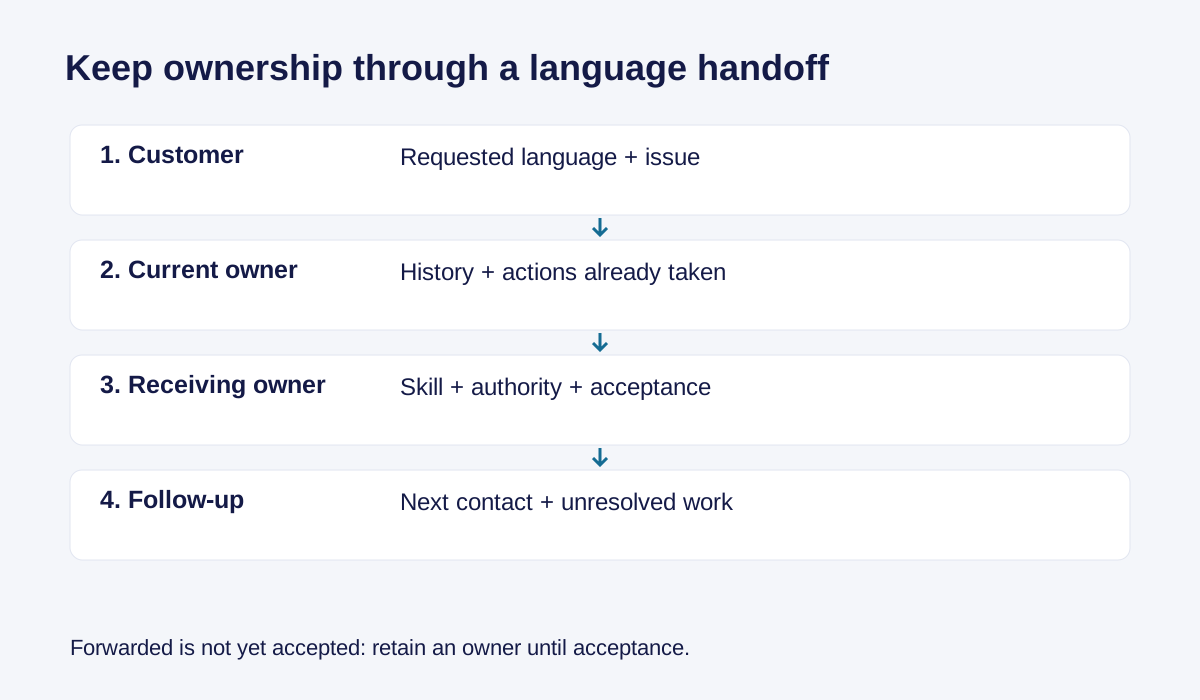
An email sent to a specialist shows that a request was forwarded. It does not show that the specialist accepted it. Decide who follows up if the transfer has not been accepted within the agreed window.
For bilingual customer support, test at least the primary route, an unavailable-agent route and a case that requires a specialist. Include a customer who switches languages mid-conversation. Check that the language preference and case history remain usable after the switch, and that the system does not start a duplicate case without an agreed reason.
Translation assistance needs its own rules. Identify where the original text is retained, how approved product terms are applied and when a person must review an uncertain translation. An agent using chat translation should not be described as a fluent Spanish voice agent. The channel and the method of assistance belong together in the service specification.
For a Spanish language call center operating across time zones, write the follow-up promise in terms the customer can use. Agree whether a case waits for the next staffed shift, goes to an approved backup team or receives another defined form of help. Test that the promise shown to the customer matches the schedule behind it.
If local telephone numbers are part of the scope, ask which number type is proposed and which end-user documents are required. Twilio’s regulatory FAQ explains that requirements vary by country and that providers and end users both have responsibilities. Hosted provisioning should not be treated as a blanket exemption from supplying customer information or meeting the relevant conditions.
Ask suppliers to demonstrate a complete case
Compare suppliers using the same tasks and acceptance criteria. Ask each one to show a case from entry to resolution or accepted escalation, with the records a supervisor would see. A demonstration is more useful when it includes an unavailable agent and a request outside the first agent’s authority.
For Spanish call center outsourcing, request a breakdown of what the quoted service includes. Ask about staffed hours, supervision, language assessment, training, software access, number charges and the treatment of work outside the agreed scope. A quote for a shared answering team and a quote for a dedicated team completing after-sales work buy different services. Compare the team staffing options and published pricing scope before requesting a quote for the specific language pair.
| Evaluation area | Request this evidence | Unresolved question to record |
|---|---|---|
| Language capability | Assessed spoken and written tasks | Who reviews an ambiguous response? |
| Coverage | Schedule with backup arrangements | What happens when the primary skill is unavailable? |
| Authority | Task and escalation matrix | Which actions require the customer’s approval? |
| Continuity | One case crossing channels or teams | Who owns it while waiting for acceptance? |
| Quality | Applicable rubric and reviewed examples | Are results available separately by language and task? |
| Reporting | Defined measures and denominators | Does an aggregate hide an unanswered language queue? |
A Spanish BPO proposal may use a shared pool, dedicated staffing or a hybrid arrangement. Evaluate each against the actual work and service window. Do not infer dedicated availability from a company-wide language count, and do not infer full case resolution from the number of messages answered.
Callnovo.ai provides human support in 65+ languages, with staffing and language requirements confirmed by project. Callnovo.ai’s multilingual customer support service can be scoped around the language pair, channels, hours and escalation requirements. In a separate anonymous South American logistics project, the operation used Spanish and Portuguese language-and-intent routing, with reporting by language, skill group, period and issue. It illustrates why the reporting dimensions should follow the work; it is a different project from the English–Spanish auto-parts setup described above.
For bilingual Spanish customer service, agree who will review the Spanish interactions and how disputed scores will be handled. Ask for the original conversation and relevant policy when examining a result. Customer satisfaction, quality scores and response time answer different questions, so request their definitions rather than combining them into one unexplained success percentage.
Run a limited pilot against the agreed tasks before expanding coverage. Record the cases attempted, observed failures, corrective actions and retest results. The pilot should include the difficult paths you expect to buy, not only a scripted greeting and a routine lookup.
Put the agreed coverage in the statement of work
Before accepting Spanish call center services, check that the written scope answers these questions:
- Which language pair, markets and business tasks are included?
- Which channels have fluent human coverage, translation assistance or AI responses?
- What are the staffed hours, time-zone convention and holiday arrangements?
- What happens when the language skill or required specialist is unavailable?
- Who owns a transferred case until the receiving team accepts it?
- Which system permissions and customer approvals are required?
- How will language-specific quality and customer outcomes be reviewed?
- Which pilot failures must be corrected and retested before expansion?
Take the same specification to each supplier of bilingual call center services. Keep unanswered staffing, routing and permission questions visible in the proposal until the supplier demonstrates the agreed behavior and records it in the scope of work.
References
- Zendesk: About using skills to route tickets. Undated. Accessed October 30, 2026.
- Microsoft: Overview of skill-based routing; updated March 18, 2026. Updated March 18, 2026. Accessed October 30, 2026.
- Twilio: Phone number regulatory FAQ. Undated. Accessed October 30, 2026.