

Multilingual Call Center Services: The Two Questions Nobody Asks
Evaluate multilingual call center services by local phone access, staffing continuity and translation support. Use practical questions to assess your coverage.

When evaluating multilingual call center services, ask how each language will be staffed, how customers will reach the team and who will cover an absence.
The number is the easiest thing to ask about and the least useful. A vendor can add an entry to that list faster than you can finish the call. What that list never tells you is whether the arrangement survives contact with an actual customer in that market.
Two things decide that, and neither one is a linguistic question.
Multilingual call center services are customer support operations staffed by agents who speak the languages your customers actually use, usually paired with a local number they can dial.
On this page
- TL;DR: What the count hides
- The telecom layer: speaking Thai doesn’t help if nobody can dial you
- The retention layer: your multilingual agent is the most likely one to leave
- Bilingual is not multilingual, and the difference is operational
- The software side: four layers of a multilingual help desk
- Five questions to ask any multilingual vendor
- FAQ
TL;DR: What the count hides
| What buyers ask | What actually decides it | If the vendor can’t answer |
|---|---|---|
| ”How many languages do you support?” | Whether customers in that market have a local number to dial | They are staffing a language they cannot receive calls in |
| ”Are your agents native speakers?” | Whether that specific agent is still there in twelve months | They are quoting a capability with no continuity behind it |
| ”What’s your CSAT?” | Whose CSAT — the blended average, or that one line | A blended figure hides a line that has collapsed |
A multilingual call center fails in one of two places that a count never reveals. Can customers in that market reach a local number, and will the agent who speaks their language still be there in twelve months?
Everything below is those two places, in order.
The telecom layer: speaking Thai doesn’t help if nobody can dial you
Linguistic capability and reachability are separate purchases. They get sold as one thing and they are not one thing.
Staffing is the fast half. A vendor with an existing recruiting pipeline can put a native Thai speaker on your queue in a matter of weeks. Getting a Thai local number for that customer to call is a different process entirely, and it does not run on the same clock.
Number requirements depend on the country, number type and end user. Ask which identity, address or business documents are required for the proposed number. Hosted provisioning can organize the application and routing, but does not automatically remove the customer’s obligations. Twilio’s regulatory FAQ describes the shared responsibilities of providers and end users.
| Question | Direct or hosted provisioning |
|---|---|
| Which documents are required? | Confirm for the country, number type and end user |
| Is a local address required? | Verify the specific number’s conditions |
| Who supplies and checks documents? | Name the customer and provider responsibilities |
| When can calls reach the queue? | Confirm approval, activation, routing and a successful test call |
For a proposed market, review local number provisioning and confirm number availability, required documents and the activation plan before advertising the number to customers.
The asymmetry between the two is what makes this worth checking during procurement. A missing speaker shows up as complaints, which get escalated and fixed. A missing number shows up as silence — and silence in a market report reads as low demand, so nobody goes looking.
The practical test for any vendor is short: ask for the provisioning lead time in your three largest non-English markets. A vendor with carrier relationships answers in days or weeks. A vendor without them changes the subject to coverage.
The retention layer: your multilingual agent is the most likely one to leave
The second question is harder to ask because the answer is uncomfortable for most vendors.
Multilingual delivery concentrates offshore. That is the economics of the thing — the pool of people who speak Thai, Arabic, Portuguese and Japanese to a professional standard, and who will work a support queue, is not sitting in Ohio. And offshore is exactly where agent turnover is worst.
The numbers are not close:
- US onshore voice attrition runs at a 31% mean and a 24% median (ContactBabel, 2024) — from the US Contact Center Decision-Makers’ Guide, year-end 2023 data across 189 US contact center managers.
- Philippine offshore voice runs at 45% for 2022 and 43% on 2023 data (CCAP, 2025) — the Attrition and Retention Survey, conducted by Willis Towers Watson across 145 member organizations.
These surveys cover different populations and periods. They do not establish a causal onshore/offshore difference or the expected turnover of a particular language team. Ask for the proposed team’s own retention and backup arrangements.
Replacement is not free either. average cost per hire is US$4,683 against a median of US$1,244 (SHRM, 2022), and that is only the acquisition line. It does not include the ramp, during which a new agent is handling your customers at a lower standard.
For an English queue, a departure is absorbed. Someone else picks up the volume while a replacement ramps. For a line staffed by one person, there is no one else. This is what actually happens:
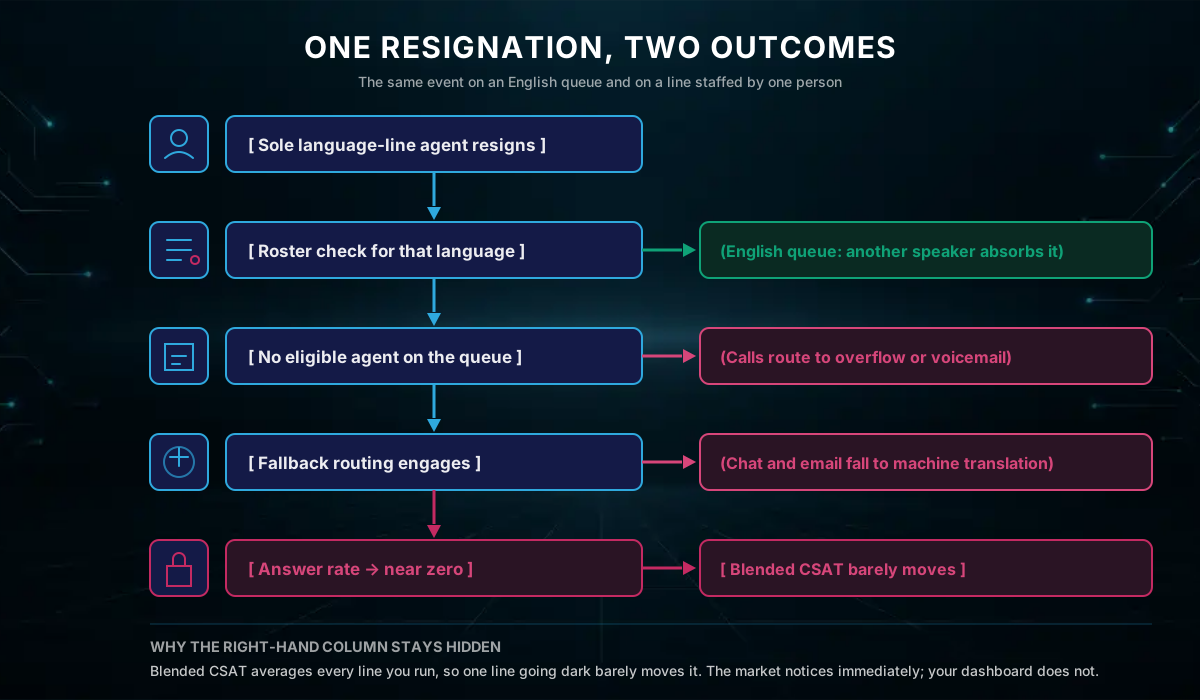
That last step is the reason this is worth your attention during procurement rather than after. A blended customer satisfaction number is an average across every line you run. One line going dark moves it by very little. The market it served notices immediately; your dashboard does not.
So ask for tenure in the specific language you need, not the company average. And ask how many agents cover it. “We support Portuguese” and “we have one Portuguese speaker” are the same sentence on a capability page.
Bilingual is not multilingual, and the difference is operational
One more distinction worth making, because it is the single thing most buyers and most vendor pages collapse.
Bilingual staffing and multilingual staffing are different operating models. Bilingual teams work across one language pair, often English and Spanish. Check which agents have the required language and task skills in each staffed period; interchangeability depends on the actual roster. Multilingual coverage requires a separate hiring pipeline, a separate schedule, and a separate quality baseline for every entry on the list. If you need English-and-Spanish phone answering, review our bilingual answering service. For work across phone, email and chat, scope the channels and responsibilities with our multilingual support team.
| Bilingual model | Multilingual model | |
|---|---|---|
| Hiring pipeline | One pipeline, wider filter | One pipeline per tongue |
| Scheduling | Match language and task skills to each shift | Match each language requirement to a staffed shift |
| Quality baseline | One rubric | One rubric per tongue, scored by someone who speaks it |
| Effect of one departure | Depends on qualified backup | Depends on qualified backup |
| What to test | Peak demand and unavailable agents | Peak demand and unavailable language skills |
Both are legitimate. They are priced differently and they fail differently, and a vendor that quotes you one while you are buying the other will look cheap right up until the day it doesn’t.
This is the part of multilingual customer service outsourcing that is worth paying for. Not the list itself, but the pipeline behind each entry on it. It is also the reason buyers who compare multilingual call center outsourcing on headline rates alone tend to re-run the exercise a year later. A global rollout stalls on the one line nobody was staffing twice. Callnovo.ai offers human support in 65+ languages; native or non-native staffing for Spanish, German, French and Japanese is agreed by project, and reports average agent tenure of 4.2 years — a figure that only means something set against the ContactBabel and CCAP numbers above, which is why we put those first. Internal promotion runs at 34%, and agents receive 120 hours of training per year. Those three numbers are the same fact seen from three angles: people stay, so the language line stays.
How we staff and price teams runs from half a seat to 200+ seats rather than a five-seat minimum, which matters when a language line genuinely needs one person. A rare language line is exactly where quality problems hide longest. Published pricing shows the per-seat quality add-on that reviews every conversation — not a 2–5% sample — is the mechanism that surfaces them before the market’s revenue does.
When we’re not the right fit
- You need only English and Spanish. Compare proposals for that language pair, its staffed hours and the tasks involved; a narrower language scope does not by itself establish which provider is cheaper.
- Your procurement policy requires onshore agents only. Our delivery is multi-country, run from our own operation centers, and the staffing economics above are the reason.
- You want a number in a country you’re only testing. Provisioning is worth it where you’re committed. For a three-month test, a regional number and clear hours is the honest answer.
- The count is your comparison column. We won’t win it. Someone will always list more.
Define English–Spanish coverage by task and time
An anonymous auto-parts project used an English–Spanish AI front end for standard questions, with a human handling complex returns, compatibility, installation and damaged-item cases during the stated PST 8:00–17:00 window. Automated availability and staffed availability were separate parts of the design.
For your own proposal, specify channels, language assessment, human hours, transfer ownership and the out-of-hours route. Our bilingual call center services guide provides task tests and a handoff checklist. Confirm the time-zone convention and holiday coverage for the proposed project rather than copying another project’s schedule.
The software side: four layers of a multilingual help desk
Everything above is about people. The software those people work in has the same problem, and it is sold the same way: by a count.
A multilingual help desk has four layers, and each one is configured for languages separately. Real-time translation covers the first.
| Layer | Who sees it | What goes wrong | What to ask the vendor |
|---|---|---|---|
| The conversation | Customer and agent | Live chat translation renders each message, but a handoff stalls when the earlier transcript is still untranslated | Which channels are translated, and can an agent translate the history before taking over? |
| The chat widget | The visitor | In a multilingual live chat window, buttons follow the visitor’s device settings while the greeting exists only in the languages your team wrote | Which widget text follows the visitor, and which do we write ourselves for every locale? |
| The agent workspace | The agent | Field names, ticket statuses and priorities were written once, in whatever the administrator speaks | Can each agent read fields, statuses and priorities in the interface they chose? |
| The chatbot | The customer | A multilingual chatbot answers a Spanish question from help articles that exist only in English | In which languages is the knowledge base actually written? |
The third row is the one buyers skip. Zendesk built a dedicated mechanism for it, called dynamic content: an administrator writes a default text plus one variant for each of the supported languages, and a placeholder displays the variant that matches the user. A vendor does not build that for a problem nobody has.
On the conversation layer, HeroDash, the platform Callnovo.ai agents work in, offers two-way real-time translation in 100+ languages. Its AI assistant drafts a reply in whatever the customer wrote in, and covers seven channels: website chat, WhatsApp, Facebook, Instagram, LINE, eBay and TikTok. An agent picking up a conversation can translate its history in one click. That figure is real-time translation. It is a separate number from the 65+ languages staffed by human agents described above, and the two should never be added together on a comparison sheet.
Translation carries routine written questions. A phone call, or a complaint where tone decides the outcome, is where a staffed line earns its cost. Where one market has too little phone volume to staff, call center translation services put an interpreter on a three-way call. A multilingual contact center usually ends up running all three: translated text, interpreted calls for the long tail, and staffed lines where the volume pays for them.
Five questions to ask any multilingual vendor
Take these to every vendor on your list, including us. They are answerable in one sitting by anyone who actually operates what they’re selling.
- What is the number provisioning lead time in my three largest non-English markets — and do you hold carrier relationships there, or resell?
- What is agent tenure in the specific language I need, not the company average?
- How many agents cover that language today? If the answer is one, what happens the week they resign?
- Is customer satisfaction reported per line or blended? A blended figure cannot show a collapsed line.
- What percentage of conversations get quality-reviewed in that language, and who scores them — someone who speaks it, or a translation?
A vendor that answers all five has operated a multilingual floor. A vendor that redirects to the count has a list.
References
- ContactBabel, US Contact Center Decision-Makers’ Guide, 2024 edition (year-end 2023 data, 189 US contact center managers) — https://www.contactbabel.com/
- CCAP Attrition and Retention Survey, conducted by Willis Towers Watson across 145 member organizations, reported May 2025 — https://ccap.ph/
- SHRM, 2022 Talent Access Report (average cost per hire) — https://www.shrm.org/
- Callnovo.ai multilingual support capability — https://callnovo.ai/services/multilingual/
- Zendesk Help, Providing multiple language support with dynamic content — https://support.zendesk.com/hc/en-us/articles/4408882999066
- Magellan Solutions, multilingual inbound services
- OnBrand24, multilingual call center
- Outsource Accelerator, multilingual call centers
- Fusion CX, multilingual services
Questions buyers ask
- What are multilingual call center services?
- Multilingual call center services provide customer support across several languages using agents who speak them, usually combined with local phone numbers in the markets served. The two operational requirements behind the language list are reachability — a local number customers can dial — and retention, since a language line staffed by one agent stops when that agent leaves.
- What is the difference between bilingual and multilingual support?
- Bilingual support covers two languages, often English and Spanish; multilingual support covers more. For either model, define the language and task skills on each shift, backup arrangements and quality review. The effect of an absence depends on the qualified backup available.
- Do I need a local phone number in each country I sell into?
- Choose numbers according to customer reachability and the intended markets. Requirements depend on the country, number type and end user. Confirm documents, provider and customer responsibilities, activation and routing; hosted provisioning does not automatically remove customer obligations.
- How high is agent turnover at multilingual call centers?
- Multilingual delivery concentrates offshore, where turnover is highest. ContactBabel reports a 31% mean and 24% median annual attrition for US onshore voice in its 2024 guide, while the CCAP survey reports 43% for Philippine offshore voice on 2023 data. Ask any vendor for tenure in the specific language you need rather than the company average.
- Can you translate a live conversation?
- Yes. Live chat translation works in two passes: the customer's message is translated for the agent when it arrives, and the agent's reply is translated back before it is sent. What a standalone translator leaves outside the ticket is the conversation history, the product terms, and the handoff to the next agent.