

Key Takeaways
- Professional drone buyers don’t want a refund — they want the product to work. When a gimbal won’t calibrate two days before a paid shoot, the buyer needs an engineer, not a returns label.
- A FAQ answer is a signal that the brand doesn’t take the market seriously. Prosumer buyers ask questions a troubleshooting document can’t answer, and they tell each other everything.
- Native language plus technical depth changes the diagnosis. A buyer describing a fault in their own language is precise; translating into English adds ambiguity that costs resolution time and sometimes the sale.
- Structured support data surfaces product issues early. One logged gimbal error becomes a codified five-minute fix for later buyers — and a firmware update that removes the error for everyone after them.
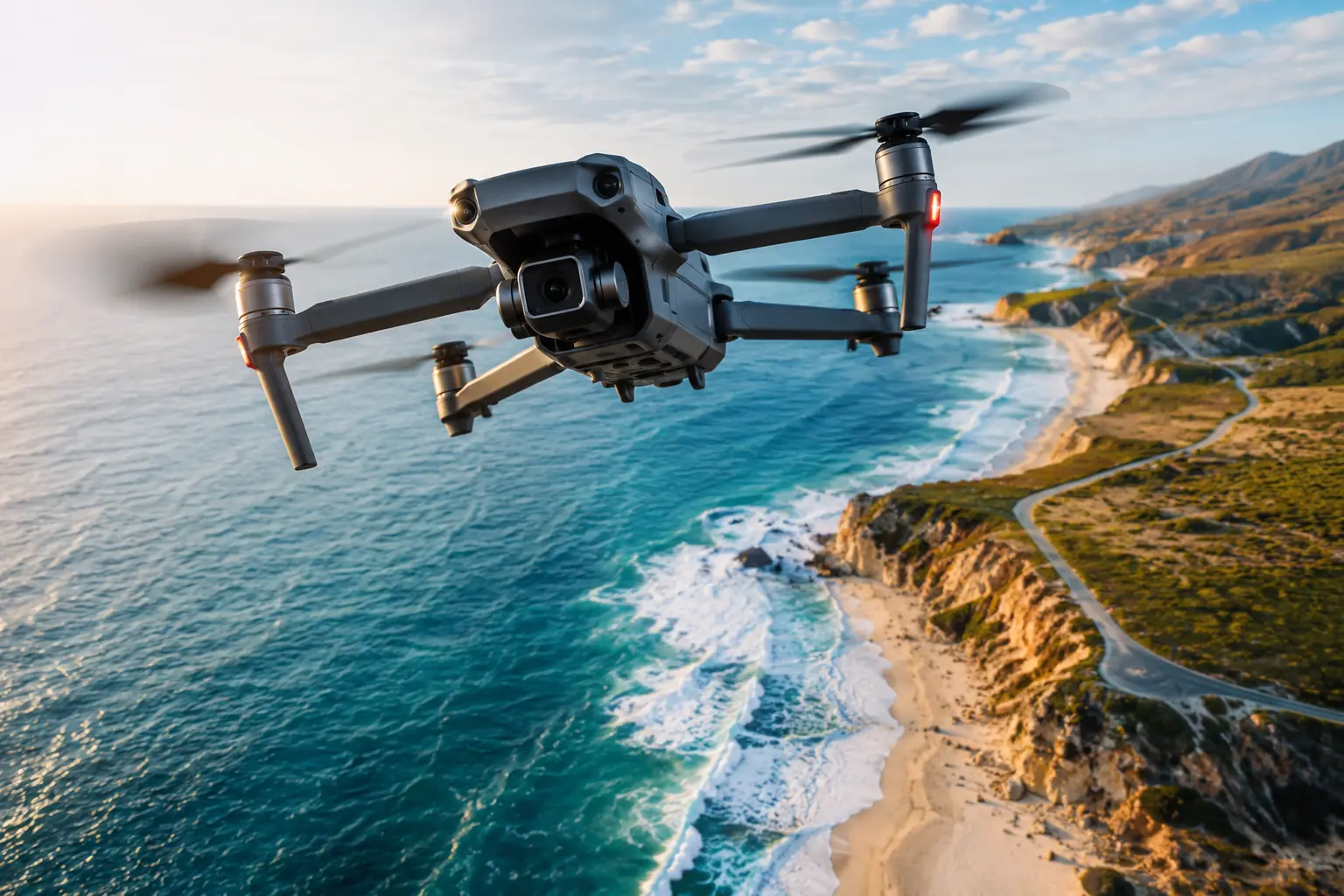
A professional photographer bought a $2,400 drone for a commercial shoot. The gimbal wasn’t calibrating correctly. What happened next — a multilingual technical support call handled in her own language, not a refund offer — determined whether the brand kept a customer who would tell twenty colleagues about them, or lost one who would do the same.
The call that tests whether a support team actually knows the product
The customer was a commercial photographer based in the Netherlands. She had pre-ordered the drone three months earlier, planned a coastal shoot around its delivery, and unboxed it two days before the job.
The gimbal initialization was throwing an error she hadn’t seen in any review or tutorial. The horizon wasn’t stabilizing correctly in windy conditions — not dramatically wrong, but wrong enough that she couldn’t use the footage commercially. She had a client, a location booking, and a deadline. She needed the drone to work, and she needed to know within 24 hours whether it was going to.
She contacted the brand’s support line. In Dutch.
The agent who picked up had gone through eight weeks of product training on this drone line specifically — flight controller architecture, gimbal calibration sequences, common initialization errors and their diagnostic paths, firmware behavior across different operating environments. The agent wasn’t reading from a troubleshooting document. She understood what the error code meant and why it appeared under certain conditions.
Within fifteen minutes, the agent had walked the photographer through a manual gimbal recalibration sequence that wasn’t in the standard user guide — a procedure that Callnovo’s training team had developed after observing a pattern in early support contacts for this model. The horizon stabilized. The shoot happened.
The footage was fine, the client was happy — and I'm recommending the brand to three colleagues who are looking to upgrade their equipment.
Commercial photographer, Netherlands (composite account)
That outcome wasn’t guaranteed by the product. It was created by a support interaction that lasted fifteen minutes.
Why drone support is a different category of problem
Consumer drone brands selling into professional and prosumer markets face a support challenge that most of them underestimate when they’re building their after-sales infrastructure. And the stakes keep rising: professional and enterprise use now drives much of a commercial drone market that Drone Industry Insights tracks as one of the decade’s faster-growing hardware categories.
The buyers aren’t casual consumers who made an impulse purchase and need basic help. They’re photographers, videographers, surveyors, agricultural operators, and inspection professionals who understand their equipment technically and have specific, often time-sensitive requirements for when it needs to work. A problem that would generate a disappointed review from a casual buyer generates a chargeback, a formal complaint, and a detailed negative post in professional communities from a professional user.
The questions these buyers ask can’t be answered from a FAQ. Gimbal calibration under specific wind and temperature conditions. Obstacle avoidance sensitivity adjustments for industrial inspection environments. Return-to-home behavior when GPS signal is degraded. Battery performance variance between different firmware versions. Interference patterns near specific types of electrical infrastructure.
An agent who responds to these questions with “please refer to section 4.2 of the user manual” has not provided support. They’ve confirmed to a professional buyer that the brand doesn’t take their market seriously — and professional buyers tell each other everything.
What the training program actually covers
Callnovo’s drone support teams go through eight weeks of product training before handling any contacts. The scope is specific to why professional and prosumer buyers call — not generic customer service processes applied to a drone product, but the actual technical content those buyers need agents to understand.
- Flight controller systems and how they interact with GPS, vision positioning, and obstacle avoidance sensors.
- Gimbal mechanics, calibration procedures, and the diagnostic sequence for distinguishing hardware faults from firmware or calibration issues.
- Battery management — charge cycles, storage discharge recommendations, performance variance by temperature, and the difference between normal degradation and fault conditions.
- Return-to-home logic and how different settings affect behavior in edge cases.
- Firmware update procedures and known issues in different versions.
Agents also go through training on the regulatory environment in the markets they cover. European drone regulations under EASA — category classifications, registration requirements, operational restrictions — are part of what professional buyers expect support agents to understand. A buyer calling from Germany who asks whether their planned flight is permitted in a specific category isn’t asking a general question. They’re asking because they genuinely don’t know, and an agent who can give them an accurate answer is providing something the buyer couldn’t easily get elsewhere.
The training produces agents who can function as a first-line technical resource rather than a routing service. When a contact comes in, the goal is to resolve it — not to collect a description and pass it to someone else. It’s the same operating model behind Callnovo’s 2,500+ agents across 40+ client accounts: specialist teams trained to each client’s product, not a generic pool routed by keyword.
The language dimension that most drone brands get wrong
Consumer drone brands selling across Europe often assume that English-language support is adequate for most markets. For prosumer and professional buyers, this assumption is consistently wrong.
A professional photographer in the Netherlands describing a gimbal behavior issue in English is translating — choosing words for technical concepts that she would describe more precisely in Dutch. The translation introduces ambiguity. The agent receives a description that’s slightly less specific than the actual fault, and the diagnostic conversation takes longer and produces less certain results.
The same professional describing the same fault in Dutch gives the agent an exact technical description. The agent who speaks Dutch natively understands immediately what the photographer means by the specific term she’s used — a term that doesn’t have a direct English equivalent and would have been approximated in translation. The diagnostic path is shorter. The resolution is more accurate.
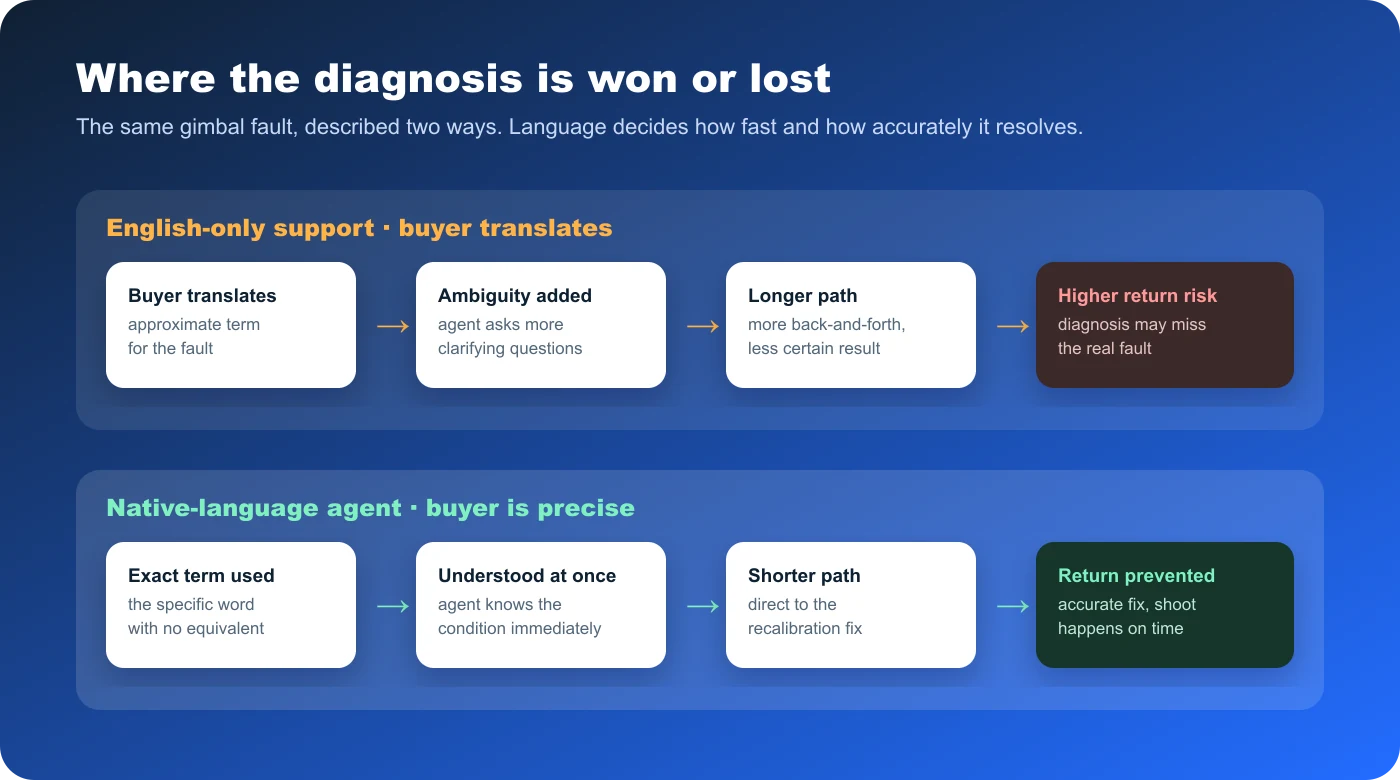
Across 65+ supported languages, Callnovo staffs native-speaking technical agents — not translation-assisted support — for each European drone market, so a Dutch buyer’s fault description reaches an agent who understands the exact term without approximation. For drone lines that means native-language agents in Dutch, German, French, Italian, Spanish, and more, each trained on the same technical content as the English-language team.
The combination — technical depth and native language — is what changes the character of the support interaction. Without both, something is always being lost in translation, literally or figuratively.
What warranty and returns look like for a $2,400 product
High-ticket drone returns are expensive in ways that go beyond the reverse logistics cost. A returned drone has to be inspected to determine whether the fault was user error, product defect, or shipping damage — each of which has a different resolution path and a different cost allocation. Inspection takes time and requires technical competence. Restocking or write-off decisions depend on the inspection outcome.
The support interaction before a return request is filed is the highest-value intervention point. A buyer who has contacted support and received a resolution — a calibration procedure that fixed the issue, a firmware update that addressed the behavior, a clear explanation of why what they observed is within normal operating parameters — doesn’t file a return. A buyer who contacted support and received a generic response or an incorrect diagnosis often does, even if the product would have been fine with the right guidance.
On the warranty side, professional buyers often have specific questions about coverage terms — what’s included, what conditions void coverage, how to initiate a warranty claim, what the turnaround time looks like. These questions need accurate answers. An incorrect warranty commitment made by a support agent creates a liability. An accurate explanation of coverage terms that leaves the buyer clear on where they stand is support done correctly.
HeroDash logs every interaction — the issue description, the diagnostic steps taken, the resolution provided, and the outcome — so that if a warranty dispute arises later, the record of what was communicated and when is available and auditable. For a $2,400 product where disputes carry real financial consequence, that documentation is not a minor operational detail.
What happens when the same issue appears in multiple contacts
The gimbal calibration issue that appeared in the Dutch photographer’s contact wasn’t a one-off. Over the following weeks, similar contacts came in from other buyers in different markets — the same error code, the same symptom, different operating environments.
Because every contact is logged with structured tags in HeroDash, real-time quality monitoring made the pattern visible quickly. The support team identified it, documented the resolution sequence that was working, and shared it across all agents handling this drone line. What had been a fifteen-minute diagnostic conversation for the Dutch photographer became a five-minute resolution for buyers who contacted support later — because the team had already worked through the diagnostic path and codified it.
Contact logged
Every gimbal error is captured with structured tags: error code, firmware version, market, and operating conditions.
Pattern surfaces
The same code appears across markets. Structured data makes the cluster visible in weeks, not quarters.
Resolution codified
The working recalibration sequence is documented and shared, cutting a 15-minute diagnosis to a 5-minute fix.
Product team acts
The structured report drives an updated quick-start guide and a firmware update that reduces the error frequency.
That pattern data also went back to the brand’s product team. Not as a complaint log, but as a specific, structured report: this fault code, appearing under these conditions, resolved by this procedure, affecting this volume of units. The product team used it to update the quick-start guide and push a firmware update that reduced the frequency of the initialization error.
The support operation didn’t just resolve the individual contacts. It surfaced a product issue early enough for the brand to address it before it accumulated enough reviews to affect conversion on their listings.
Three questions drone brands should ask about their current support setup
If you’re selling consumer or prosumer drones in North American or European markets, these are the questions that determine whether your support operation is protecting your brand or quietly working against it.
- Can your support agents resolve a gimbal calibration issue, a return-to-home behavior question, or a battery fault diagnosis without escalating? If most technical contacts require escalation to a second line or back to your internal engineering team, the support infrastructure isn’t deep enough for the buyers you’re selling to.
- Are your European market contacts being handled in the buyer’s native language by someone who understands the technical vocabulary? English-language support for Dutch, German, or French professional buyers introduces diagnostic friction that costs resolution time and sometimes costs the sale.
- Is your support data structured well enough to surface product patterns before they accumulate into review problems? A fault that appears in twenty contacts in a month is a product signal. If those twenty contacts are logged as unstructured text in a helpdesk tool, that signal stays invisible until it shows up in your listing’s review score.
The Dutch photographer’s shoot happened because a support agent knew what to do with a gimbal initialization error at 9pm on a Wednesday. That knowledge didn’t come from reading the manual. It came from eight weeks of technical training and a support infrastructure built for the buyers this brand was actually selling to.
The return that didn’t happen, the referrals that did, and the firmware update that reduced the error frequency for every subsequent buyer — all of it started with a fifteen-minute phone call that went the right way.
FAQ
Why do professional drone buyers want technical support instead of a refund?
Professional and prosumer drone buyers have deadlines, client bookings, and specific technical requirements. When a gimbal or calibration issue appears, they need the product working within hours, not a refund weeks later. A support agent who can resolve the fault keeps the customer, the sale, and the review — and often earns referrals inside a tight professional community.
What should drone technical support agents be trained on?
Agents supporting prosumer drones should understand flight controller architecture, gimbal calibration and diagnostic sequences, battery management and degradation, return-to-home logic, firmware versions and known issues, and the regional drone regulations — such as EASA category classifications in Europe — that professional buyers ask about.
Does native-language support matter for drone after-sales?
Yes. A professional buyer describing a technical fault in their native language gives an exact description, while translating into English introduces ambiguity that lengthens diagnosis and reduces accuracy. Native-language agents trained on the same technical content resolve faults faster and prevent avoidable returns.
How does structured support data reduce drone returns and negative reviews?
When every contact is logged with structured tags, recurring faults become visible early. Teams codify the working resolution to cut diagnostic time for later buyers, and send the pattern to the product team to update guides or push firmware fixes before the issue accumulates into negative reviews.
Selling consumer or prosumer drones in North America or Europe and thinking through what technical support infrastructure actually requires? Explore HeroDash — Callnovo’s support and quality-monitoring platform — or talk to our team about what the right setup looks like for your product and markets.
Scenario details drawn from composite support interactions. Client identities withheld. All performance details reflect real Callnovo operational outcomes.