

Key Takeaways
- A written SOP is not an executed SOP. MT’s diagnostic protocol was technically sound — but nobody could see whether agents in Europe were actually following it on calls.
- Generic troubleshooting on a premium product reads as incompetence. “Try cleaning the machine” on a €1,000 coffee maker tells the customer the brand doesn’t understand its own product.
- Sampling misses the gaps that produce returns. The specific execution failure that sent Antonio’s fault-free machine back was never in a manual audit sample — until AI inspection checked every call.
- Monitoring becomes improvement only as a loop. AI detection → human review → targeted coaching → SOP update → follow-up verification is what turns quality control from a report into a mechanism.
MT makes premium smart coffee machines — industrial design, precision grind technology, prices that put the product firmly in considered-purchase territory. Their after-sales SOP was detailed and technically sound. Their support team in Europe wasn’t following it. Here’s how they found out — and what they built to make sure it couldn’t happen again.
The return that shouldn’t have happened
Antonio lives in Milan. He bought an MT coffee machine — a high-end unit with programmable extraction parameters and a double espresso function he’d been looking forward to using. When the crema came out thin and the flow rate seemed off, he called the brand’s after-sales line.
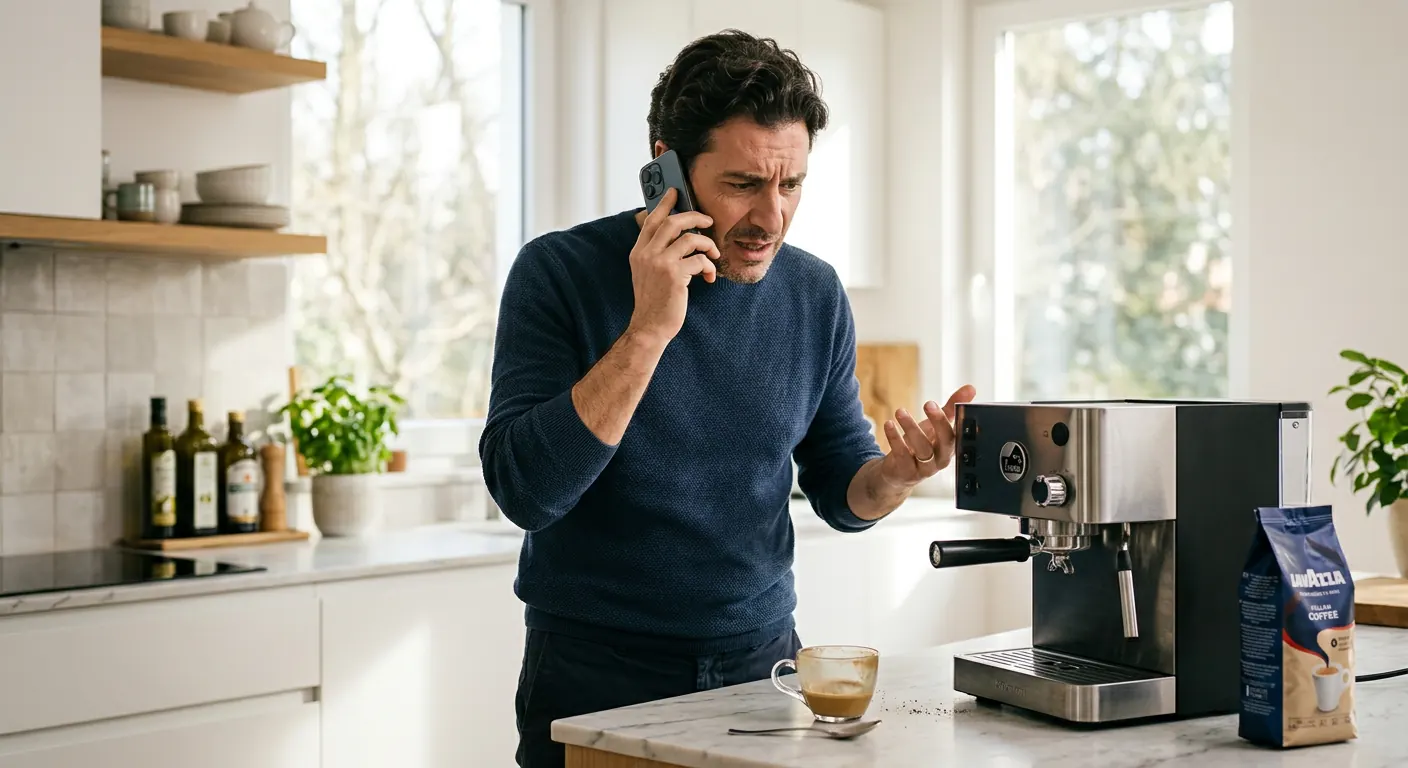
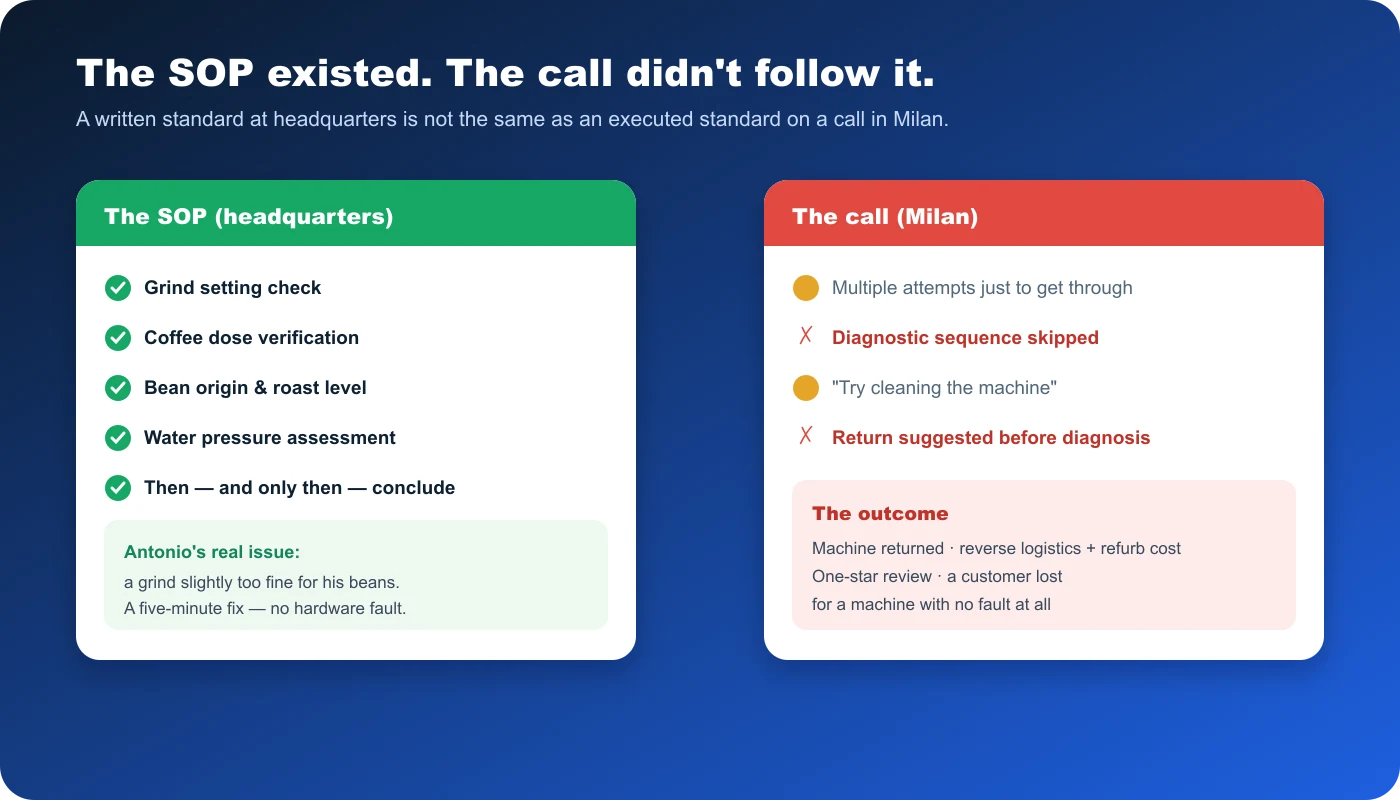
It took multiple attempts to get through. When he finally reached an agent, he described the symptoms. The agent — managing support contacts across multiple European markets simultaneously — didn’t walk him through the diagnostic sequence that MT’s SOP specified: grind setting check, coffee dose verification, bean origin and roast level, water pressure assessment. Instead, they suggested cleaning the machine. When that didn’t resolve it, they mentioned the option to return.
Antonio returned the machine. He left a one-star review. The device had no hardware fault.
MT absorbed the reverse logistics cost, the refurbishment cost, and the loss of a customer who would likely have become a loyal long-term buyer — if the extraction issue, a grind setting slightly too fine for his bean choice, had been identified and corrected in a five-minute conversation.
The frustrating part wasn’t that the agent gave wrong advice. It’s that the right advice existed, in writing, in MT’s SOP — and there was no mechanism to ensure it was being applied.
Three problems that were producing this outcome consistently
High-volume periods created access failures before service quality even became relevant. MT operates across Germany, France, Italy, Spain, and Asia Pacific simultaneously. During product launches and promotions, calls concentrated — and callers who couldn’t get through on the first attempt often didn’t try again. They went straight to the return process. The drop-off between “customer has a problem” and “customer contacts support” was invisible to management, because missed calls weren’t being tracked. A customer who never reached an agent didn’t appear in any service-quality data — they appeared later, as a return with no prior support contact recorded.
Complex products were receiving generic troubleshooting. A premium smart coffee machine has a specific failure-mode taxonomy. Thin crema has a different diagnostic path than insufficient milk foam, than extraction-speed issues, than app connectivity problems. The same symptom can have multiple causes, and the correct sequence depends on which cause is most likely given the customer’s usage context. Agents who hadn’t deeply internalized the SOP defaulted to generic responses — “clean the machine,” “restart the device” — that addressed common causes of common complaints and missed the specific cause of a specific symptom. On a product at this price point, that reads as a brand that doesn’t understand its own product.
SOP execution was invisible to headquarters. MT had invested serious effort in rigorous protocols: the grind-check sequence, bean and roast verification, the extraction-parameter walkthrough, the exact questions to ask before any conclusion. Whether those protocols were followed on real calls was unknown. Periodic manual sampling covered a small fraction of interactions. The rest were a black box.
We spent significant effort writing the technical SOP. Whether support was using it, how they were using it — we had no visibility.
After-Sales Director, MT Brand (name anonymized)
The gap between a written SOP and what actually happens on the floor is an operations-management problem before it is a software problem — an operations manager running 105 agents describes the same tension from the inside.
Three changes that closed the gap between written standard and actual execution
Change one: missed calls become active callback tasks
When a call to MT’s support line goes unanswered, HeroDash automatically creates a callback task — recording the caller’s number, the time of the missed call, and the relevant language market. The task is routed to an Italian-, French-, German-, or Spanish-speaking agent depending on the market origin of the call.
When the agent picks up the task, they first check whether the caller has any prior service history, then call back proactively: “We saw you contacted MT’s after-sales team earlier — is now a good time to take a look at the machine together?”
The mechanism isn’t just making the call. It’s making the call with context — opening a structured service interaction rather than a cold reconnection, and giving the customer the experience of being actively followed up rather than having fallen through the cracks. A customer who receives that callback is in a very different emotional state than one who spent twenty minutes redialing and gave up.
Change two: AI quality inspection on every call, not a sample
After each call ends, HeroDash’s AI quality-inspection system automatically transcribes the recording and runs semantic analysis against MT’s defined quality indicators. Three indicator categories apply to every coffee-machine support interaction.
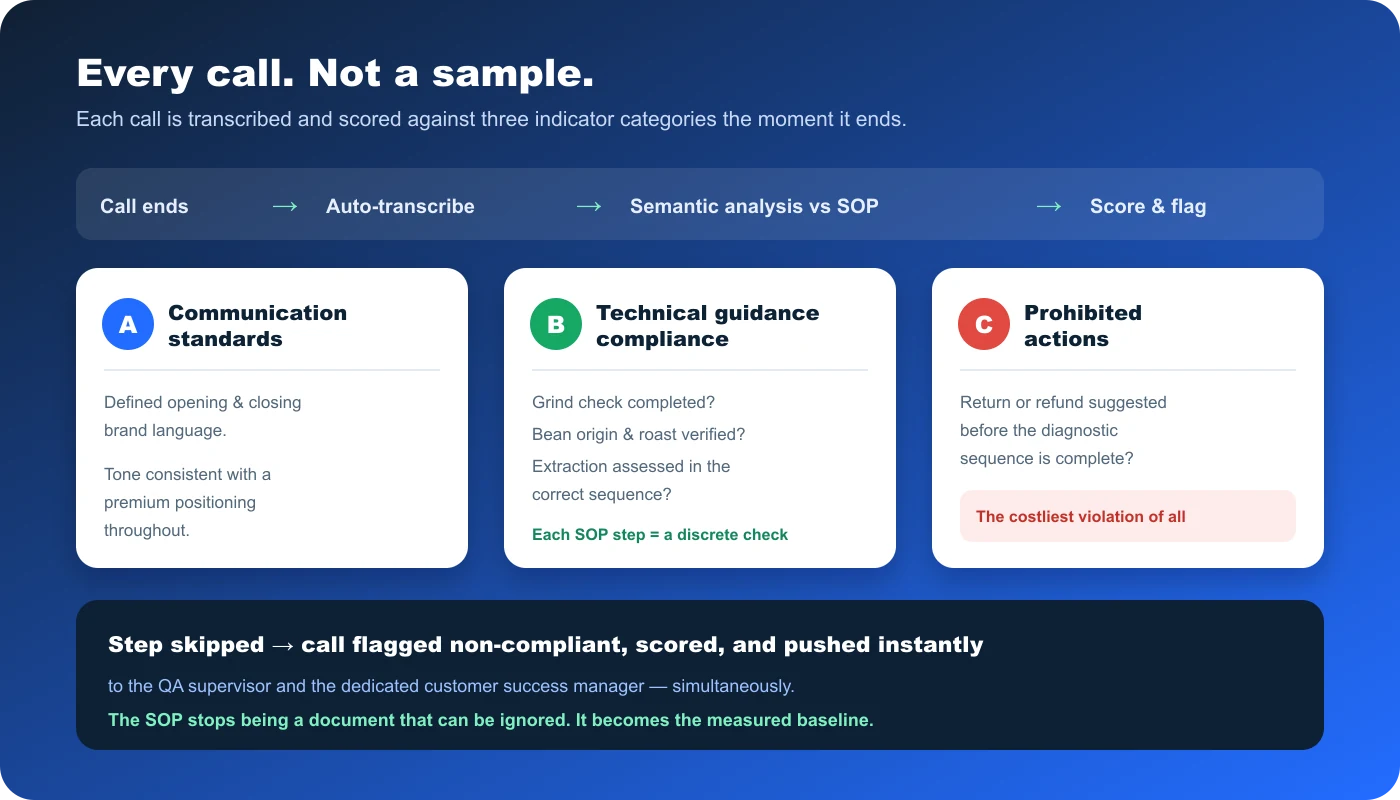
- Indicator A — Communication standards. Did the agent use MT’s defined opening and closing brand language? Was the tone consistent with the brand’s premium positioning throughout?
- Indicator B — Technical guidance compliance. Did the agent follow the diagnostic SOP? Was the grind-setting check completed? Was bean origin and roast level verified? Were extraction parameters assessed in the correct sequence? Each SOP step is a discrete check — the system identifies whether it occurred, not just whether the agent mentioned the topic.
- Indicator C — Prohibited actions. Did the agent suggest returning the product or open a refund discussion before completing the diagnostic sequence? This is the most significant violation category — the one that directly produces avoidable returns on machines with no hardware fault.
When the AI detects a skipped step — the grind check omitted, the bean verification missed, a return suggested before diagnosis was complete — the call is automatically flagged as non-compliant, scored, and a report is pushed to the quality-inspection supervisor and the dedicated customer success manager simultaneously.
Agents know that every call is inside this system. Not a sample. Every call. The SOP stops being a document that could theoretically be ignored and becomes the operational baseline the quality system actively measures against.
Change three: flagged calls trigger immediate targeted coaching
When MT’s dedicated customer success manager reviewed the recording from Antonio’s call, a specific gap emerged: the agent had checked the grind setting but hadn’t asked about bean roast level or how long the beans had been open. The sequence was partially correct — right area, right kind of questions — but incomplete in a way that would produce a wrong conclusion if the real cause was bean freshness rather than grind calibration.
The customer success manager pulled the recording and the ticket, ran a one-on-one debrief showing exactly which questions were missing and why they mattered, and ran a simulated-scenario training session on the same fault type. The SOP was updated to make the sequence explicit: bean variety and roast level before grind parameters, always.
Follow-up checks on later calls of the same type confirmed the updated sequence was being applied — the gap from Antonio’s call no longer appeared in that agent’s interactions, or in those of other agents who received the revised SOP.
AI detection
Every call is scored against the SOP; a skipped step is flagged non-compliant automatically.
Human review
The customer success manager pulls the recording and ticket to confirm what actually happened.
Targeted coaching
A one-on-one debrief plus a simulated-scenario session on the exact fault type.
SOP update
The procedure is revised to make the missing step explicit for every agent.
Follow-up verification
Later calls of the same type are checked to confirm the fix held.
This loop — AI detection, human review, targeted coaching, SOP update, follow-up verification — is what transforms quality monitoring from a reporting function into a continuous improvement mechanism.
What MT’s after-sales director said about the change
Now the AI quality inspection doesn't miss a single execution detail in any call. The weekly customer success report has even helped us identify where our product manual isn't clear enough for customers to follow — something we couldn't have known before.
After-Sales Director, MT Brand (name anonymized)
The second half of that quote is the part most brands underestimate. Once every interaction is structured and analyzed, the support operation stops being only a cost line and starts producing intelligence the product and documentation teams can act on.
What premium appliance brands operating across multiple markets should take from this
MT’s situation is representative of a challenge every high-end appliance brand hits at international scale: the gap between the service standard documented at headquarters and the standard actually delivered in customer interactions across countries and languages.
This gap exists in almost every multi-market operation that hasn’t built systematic quality monitoring. It isn’t primarily a training problem — agents who know the SOP still fail to apply it consistently under volume pressure, across product lines, in markets with different communication expectations. It’s a monitoring problem: without visibility into actual call execution, there’s no way to find where the deviation is happening or to intervene before it produces returns, negative reviews, and customer relationships that were never given a chance to develop.
For a product at €1,000 or above, the financial case is straightforward. An avoidable return on a premium machine costs far more than the monitoring infrastructure that would have prevented it — in reverse logistics, refurbishment, and the lost lifetime value of a customer who left a one-star review instead of a resolved extraction issue. And resolving the issue on that first contact matters more than most brands measure: first-contact resolution is one of the strongest predictors of retention, while high-effort interactions are among the strongest predictors of churn.
Three questions worth asking about your current after-sales operation:
- What percentage of your incoming support calls are missed during peak periods, and what happens to those callers? If missed calls aren’t generating callback tasks, they’re generating returns with no prior support contact recorded.
- What percentage of your calls are covered by quality inspection? If the answer is “a sample,” the specific execution gaps producing avoidable returns are probably not in the sample.
- When a quality issue is identified, what is the timeline from identification to SOP update to verification that the new procedure is being followed? If this cycle takes weeks, the same mistake is being made in every call of that type until it closes.
Antonio’s machine had no fault. The return happened because a support interaction that should have identified the issue didn’t follow the sequence that would have found it. The SOP existed. The monitoring system that would have caught the deviation didn’t. MT built that system — and the returns that were preventable are now being prevented.
FAQ
Why do documented after-sales SOPs fail in overseas markets?
A written SOP is not an executed SOP. Under volume pressure, across multiple product lines and languages, agents who know the procedure still skip steps — and without visibility into actual call execution, headquarters can’t see where the deviation happens. It’s a monitoring problem, not only a training problem.
How does AI quality inspection check every call instead of a sample?
After each call, HeroDash transcribes the recording and runs semantic analysis against defined quality indicators — communication standards, technical-guidance compliance (was each diagnostic SOP step actually completed?), and prohibited actions (was a return suggested before diagnosis?). Any skipped step flags the call as non-compliant automatically.
What happens to missed calls during peak periods?
HeroDash turns each unanswered call into a callback task with the caller’s number, time, and language market, assigned to a native-language agent. The agent checks prior service history and calls back proactively — so a customer who couldn’t get through becomes a followed-up service interaction rather than a silent return.
How does quality monitoring become continuous improvement?
Through a closed loop: AI detection flags a gap, a human reviews the recording, the customer success manager runs targeted coaching, the SOP is updated to make the sequence explicit, and follow-up checks verify the fix on later calls of the same type — for that agent and everyone who got the SOP revision.
Selling premium smart appliances across multiple international markets and dealing with the gap between documented service standards and actual execution? Explore HeroDash AI quality inspection, Callnovo’s multilingual support teams, or talk to our team about what closing this gap looks like for your product and markets.
Client brand name anonymized. Customer name used as an illustrative composite. After-sales director quote used with permission. Operational details reflect an active Callnovo partnership.