

Privacy note: To protect customer confidentiality, identifying details have been removed.
Key Takeaways
- The product was built for emergencies; the support channel wasn’t. A pet GPS tracker gets used when a pet is missing — and WW was answering those moments by email, with waits stretching to overnight.
- A missing real-time channel drove the complaint escalations. Customers who couldn’t reach a person in a crisis left reviews and disputed charges instead of waiting.
- English-only support underserved 40M+ Spanish speakers. The fix was genuine native bilingual agents from Callnovo’s Americas operations — not translation-assisted service.
- Location data demands system-level compliance. Three layers — an audited ISMS and data-protection-compliant framework, vetted-and-trained agents, and HeroDash PII masking — protect the most sensitive data a consumer product can generate.
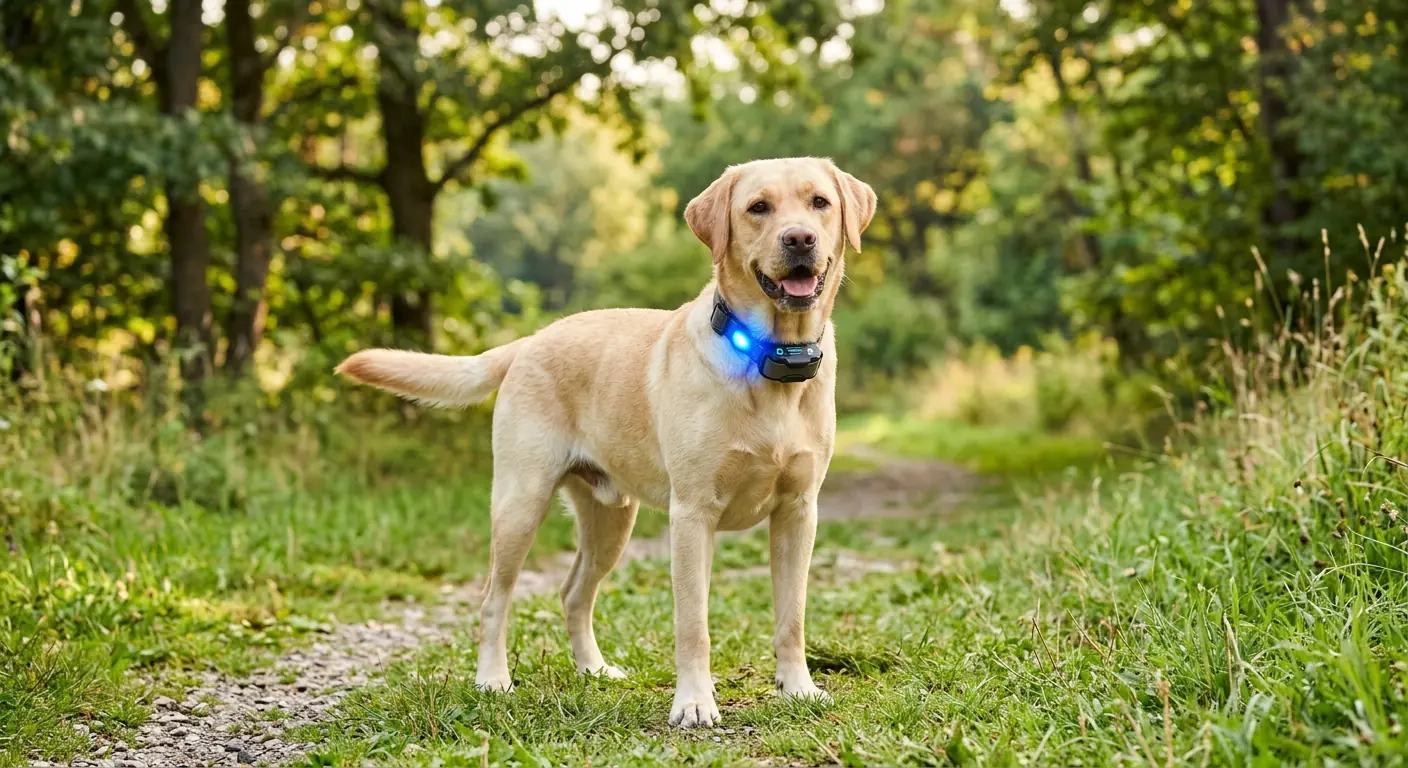
WW makes GPS pet trackers built on high-precision positioning technology. Their products sell consistently in North America. Their after-sales operation was built around email — the wrong channel for a device that people use in emergencies. Here’s how the support infrastructure was rebuilt from the ground up.
The mismatch between the product and the support channel
A pet GPS tracker is not a typical consumer electronics product. It gets used when something has gone wrong — a pet has escaped, a device has gone offline, a signal has been lost. The person contacting support isn’t browsing casually. They’re panicking.
WW’s products are built for exactly these moments. High-precision positioning, long battery life, reliable signal in a range of environments. The hardware is designed to perform under pressure. The after-sales operation they had built for the North American market wasn’t.
Support was running on email. Response times stretched across hours. A customer whose dog had gone missing and whose device was showing an error they didn’t understand sent a message and waited. Sometimes four hours. Sometimes overnight. By the time a reply arrived, the emotional context had already shifted from “I need help now” to “I left a review and disputed the charge.”
The product was designed for emergency use. The support infrastructure was designed for routine inquiries. That gap was directly responsible for a pattern of complaint escalations that were damaging WW’s North American reputation at exactly the moment they were trying to grow it.
Three problems that had become structural
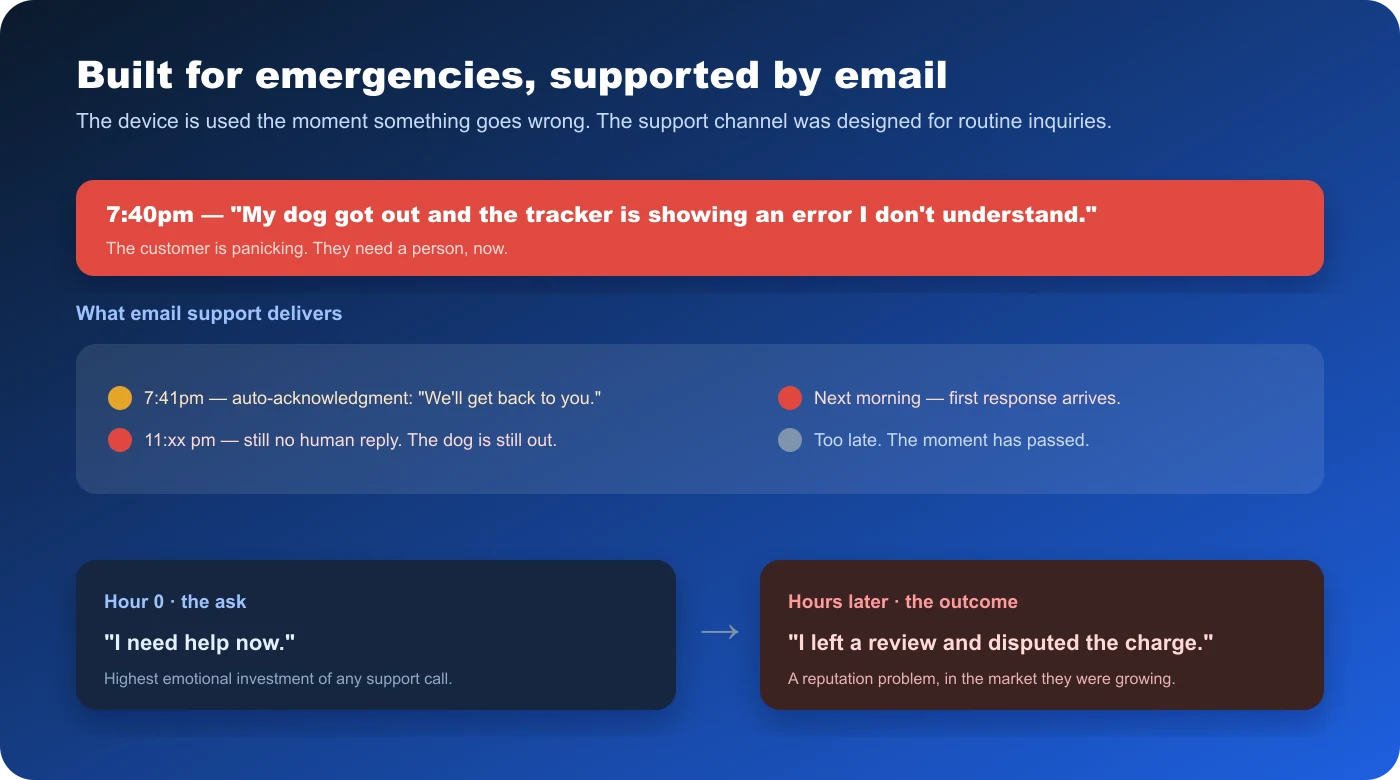
Emergency support through a non-emergency channel. Email works reasonably well for non-urgent queries — order status, return initiation, general product questions. It fails completely for a product whose use case is time-sensitive and emotionally charged. When a GPS device shows a location-drift error or goes offline while a pet is outside, the owner needs to speak to a person immediately — not receive an automated acknowledgment and wait for a queue to clear. The absence of a real-time voice channel was the primary driver of complaint escalations on WW’s North American accounts.
40 million Spanish-speaking North American consumers, no Spanish-language support. The United States has more than 40 million Spanish speakers, and a significant proportion of WW’s customer base — particularly in states with large Latino populations — preferred to communicate in Spanish. Spanish-speaking customers contacting support in English were describing technical problems with vocabulary they were translating on the fly, and receiving responses they may not have fully understood. The resolution rate for this segment was consistently lower, and the satisfaction data reflected it.
Recruiting bilingual English-Spanish agents who also understand smart hardware, cover North American hours reliably, and hold stable overnight and weekend coverage is genuinely difficult. That talent profile — native Spanish speaker, English proficient, technically literate in consumer electronics, available for North American shifts — is not easy to source through conventional hiring.
Real-time location data with no formal compliance framework. Pet GPS trackers collect continuous location data, home address information, and device binding details. This is some of the most sensitive data a consumer product can generate — it tells anyone with access exactly where a person’s home is and tracks their movements through their pet’s location history. The support operation, where agents access customer records, is the point in the chain where improper data handling is most likely to occur. Without a formal framework governing how agents access, use, and are prevented from retaining sensitive data, the risk isn’t theoretical — it’s a liability one incident could make catastrophic.
What Callnovo built for WW
| The problem | What Callnovo built |
|---|---|
| Emergency support through email; hours-long waits | A North American 800 toll-free hotline, printed on packaging, connecting to a live agent within the response window |
| No Spanish-language support for 40M+ speakers | A native bilingual EN–ES team from Callnovo’s Americas operations, trained on WW’s product line |
| Location data with no compliance framework | Three-layer data protection: an audited ISMS and data-protection-compliant framework, vetted-and-trained agents, and HeroDash PII masking |
A North American 800 toll-free hotline — printed on the packaging
Callnovo established a North American 800 toll-free number for WW and integrated it into HeroDash’s telephony infrastructure. The number appears on product packaging, instruction manuals, and after-sales cards — so a customer whose device is showing an error has an immediate, visible way to reach a real person without navigating a website or waiting on email.
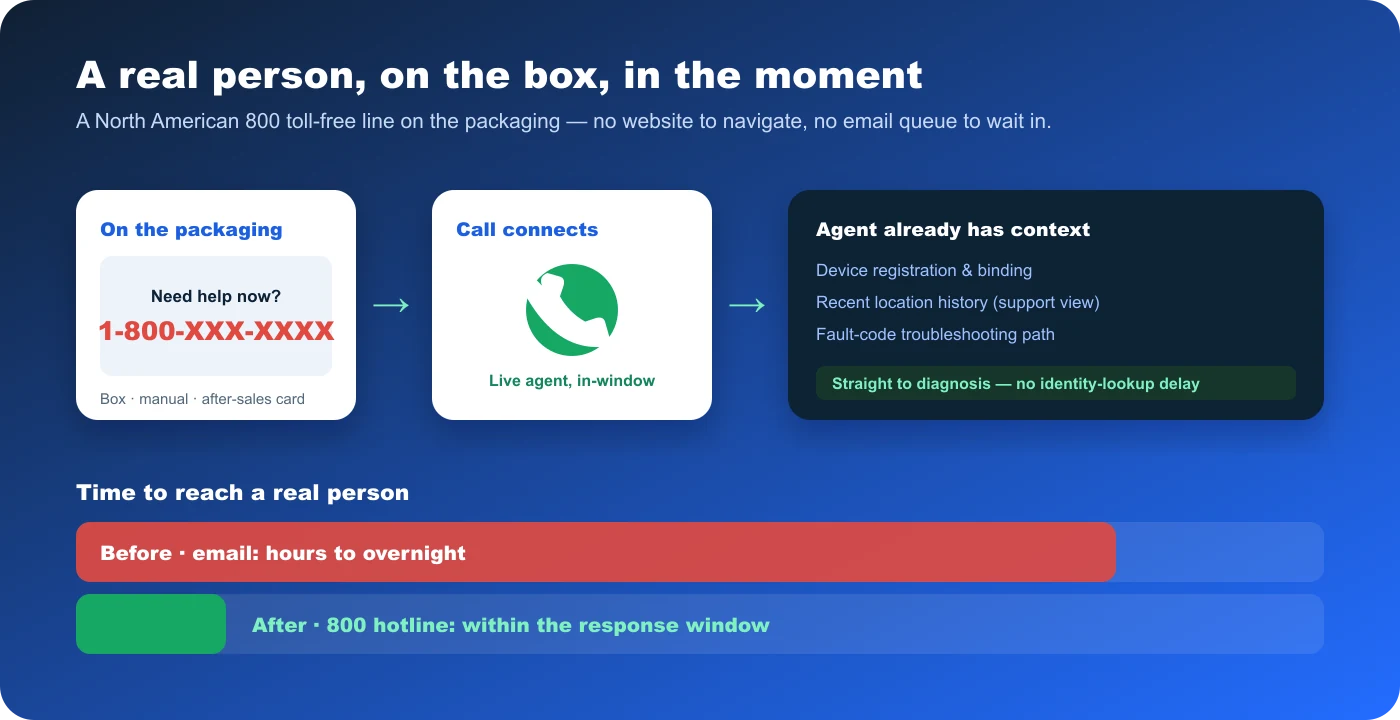
When someone calls because their pet tracker has gone offline and they can’t find their dog, the call connects to a live agent within the target response window. The agent has access to the customer’s device registration, recent location history in the support context, and the troubleshooting sequence for the specific fault code or symptom described. The conversation moves directly to diagnosis and resolution rather than starting with identity verification and account lookup.
This is what emergency product support actually requires: a channel that matches the urgency of the use case, staffed by agents who can actually help, available when customers need it rather than when it’s convenient for the support operation.
A genuine bilingual English–Spanish team from Callnovo’s Americas operations
Rather than sourcing bilingual agents through conventional recruiting — which produces inconsistent quality and high turnover for this specific profile — Callnovo deployed a team from its Americas operations center.
The agents are native Spanish speakers with genuine English fluency — not translation-assisted service, but agents for whom both languages are natural communication modes. They sit in time zones that overlap naturally with North American business and evening hours, so full coverage doesn’t require overnight shifts or the instability that accompanies them.
The team went through specialized training on WW’s product line — positioning technology fundamentals, device fault codes and their diagnostic paths, common hardware failure modes, and the communication approach for emergency-use scenarios where the caller is emotionally activated. An agent handling a call about a missing pet isn’t only providing technical support; they’re steadying an anxious person who needs to feel that someone is actively helping. That skill was part of the training.
Three-layer data protection built into the support operation
Data compliance for a pet GPS brand isn’t optional. Callnovo’s framework for WW’s account runs across three levels simultaneously.
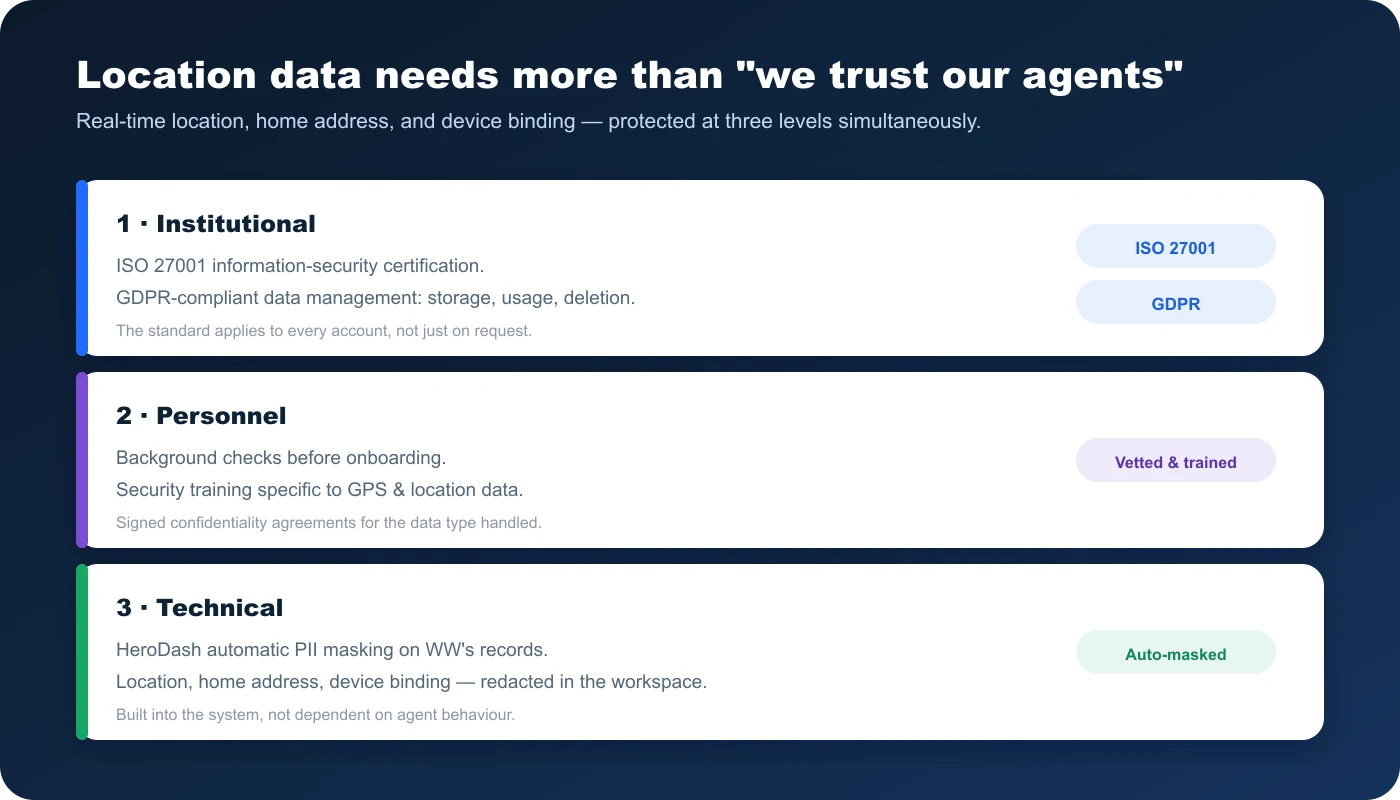
At the institutional level, Callnovo operates an audited information security management system (ISMS) and a data-protection-compliant data management framework aligned with applicable law, covering storage, usage, and deletion across all customer interactions. These standards apply to WW’s account as they do to every account.
At the personnel level, all agents handling WW’s account completed background checks before onboarding, underwent information-security training specific to GPS and location data, and signed confidentiality agreements. The training specifically addressed the sensitivity of the data type — real-time location, home address, device binding — and the handling standards that apply.
At the technical level, HeroDash’s automatic PII masking applies to WW’s customer records. Location data, home addresses, and device binding information are automatically redacted in the agent workspace. Agents see the case information they need to resolve the issue via real-time QA and controls — they cannot access or export the underlying sensitive data fields. The protection is built into the system rather than relying on agent behavior to maintain it.
Why WW chose Callnovo over other providers
WW evaluated multiple providers. Three factors determined the outcome.
- Genuine bilingual capability, not translation-assisted service. Most providers offering bilingual EN–ES support are delivering English service with translation software applied. The quality difference is audible immediately to Spanish-speaking customers.
- Americas-based operations for North American time-zone coverage. Stable North American coverage from a distant time zone requires overnight shifts, which produce turnover and inconsistency. Callnovo’s Americas operations solve this structurally — coverage is natural rather than forced.
- An audited ISMS and data-protection compliance as standard, not an add-on. For a product handling location data, the compliance requirement isn’t negotiable. WW needed a framework already operational from day one, not one built specifically for this contract.
Callnovo was the only provider that simultaneously met our three non-negotiable requirements — hotline infrastructure, bilingual service quality, and data security compliance.
Project Lead, WW (brand name anonymized)
What smart hardware brands selling safety products should take from this
Pet GPS trackers are the clearest example of a category where support infrastructure has to match the emotional and temporal urgency of the use case. But the principle applies to any hardware people rely on when something has gone wrong — medical devices, home security systems, emergency communication tools, child-safety technology.
For these products, support-channel design isn’t a secondary operational consideration. It’s a core part of the product experience. A device that performs perfectly but whose support fails in the moment of need doesn’t protect the brand–customer relationship — it destroys it, in the scenario where the customer’s emotional investment is highest.
Three questions worth asking if your hardware product falls into this category:
- When a customer has an emergency with your product, is there a phone number on the packaging they can call to reach a real person immediately? If not, the product experience has a gap that reviews will find.
- Are you covering the full language range of your North American customer base? For brands with significant Spanish-speaking segments, English-only support leaves a meaningful portion of the base underserved.
- Does your support operation have a technical compliance framework for the specific data type your product handles? For location and biometric data, “we trust our agents” is not an adequate answer — the protection needs to be built into the system.
WW’s North American after-sales operation goes live this month with infrastructure that matches what their product actually requires. The gap between what the device promises and what the support experience delivered has been closed. That’s what this project was for.
FAQ
Why is email the wrong support channel for a pet GPS tracker?
A pet GPS tracker is used in a crisis — a pet has escaped, a device is offline, a signal is lost. Email means the customer waits hours while the emergency is live. By the time a reply arrives, the interaction has shifted from “I need help now” to a negative review and a chargeback. Emergency-use products need a real-time voice channel.
Why does a pet GPS brand need Spanish-language support in North America?
The US has more than 40 million Spanish speakers, and a significant share of the brand’s customers preferred Spanish. English-only support left that segment describing technical faults in a second language and receiving answers they might not fully understand — producing lower resolution rates and satisfaction for that group.
How is sensitive location data protected in the support operation?
Through three layers at once: institutional (an audited information security management system (ISMS) and a data-protection-compliant framework aligned with applicable law), personnel (background checks, location-data security training, and confidentiality agreements), and technical (HeroDash automatic PII masking that redacts location, home address, and device binding in the agent workspace).
What makes bilingual support “genuine” rather than translation-assisted?
Genuine bilingual support uses native Spanish speakers who are also fluent in English, so both languages are natural communication modes. Translation-assisted service is English support with software applied — and the quality difference is audible immediately to a Spanish-speaking customer describing a technical problem under stress.
This is a pre-launch infrastructure rebuild — WW’s North American operation goes live in July 2026, with performance data to follow after the first peak season.