

Privacy note: To protect customer confidentiality, identifying details have been removed.
Key Takeaways
- The biggest peak-season risk isn’t the fleet — it’s the 90 seconds after landing. In the operations Callnovo supports, close to 90% of transfer disputes start at the handover, not with the vehicle.
- Transfer support is time-critical in a way ecommerce isn’t. A passenger who can’t find their driver has minutes, not hours, before “inconvenience” becomes a one-star review.
- The fix is real-time bilingual coordination, not faster tickets. One agent talking to passenger and driver at once, in both languages, with the authority to resolve on the spot.
- Peak-season staffing should be elastic and early. Deployed 15–25 days before the surge, then scaled back — cutting headcount 35% versus year-round peak staffing.

July through September is the busiest international travel period of the year. Cross-border airport transfer platforms see booking volume surge — and complaint volume surge with it. In the cross-border transfer operations Callnovo supports, close to 90% of the disputes that follow don’t come from vehicle problems. They come from a communication failure in the moment the passenger walks out of arrivals.
The moment that determines whether a booking becomes a complaint
A passenger lands after a long-haul flight. They’re tired, possibly jet-lagged, navigating an unfamiliar airport in a country where they may not speak the language. Their driver is waiting somewhere outside arrivals. Neither of them can find the other.
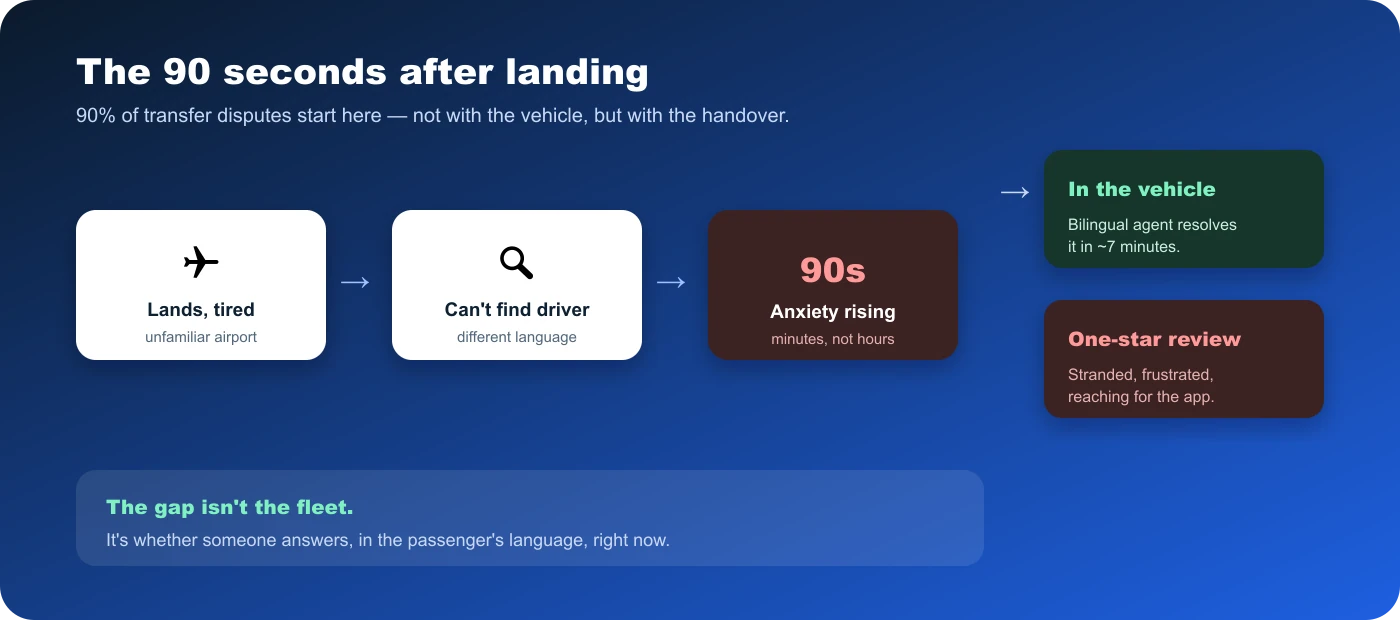
The passenger messages the platform. The platform’s support team is in a different time zone. The driver speaks a language the passenger doesn’t. The flight was delayed by 40 minutes, and nobody confirmed whether the driver is still there.
This interaction — which takes 90 seconds to go wrong — is where most cross-border transfer complaints are born. Not from the vehicle being dirty. Not from the route being inefficient. From the communication gap at the moment of handover, when the passenger is at their most anxious and least patient, and the platform’s support infrastructure wasn’t built to close that gap in real time.
July through September is when this scenario multiplies. International travel peaks. Booking volume spikes. Flight delays concentrate because airport capacity is being pushed in every major hub simultaneously. The platforms that come out of summer with their reputation intact are the ones that had support infrastructure in place before peak season started — not the ones scrambling to scale up after the first wave of complaints arrives.
Why transfer support is categorically different from standard ecommerce support
Most customer service models are built around asynchronous resolution — a customer contacts support, a ticket is created, someone responds within a defined window. For most product categories, that works.
Airport transfer support doesn’t work this way. A passenger who can’t locate their driver has a window of minutes — not hours — before the situation escalates from “inconvenience” to “I’m stranded at an airport at midnight in a foreign country and I’m leaving a one-star review right now.” Four scenarios drive the overwhelming majority of complaints, and each needs immediate, bilingual, real-time intervention.
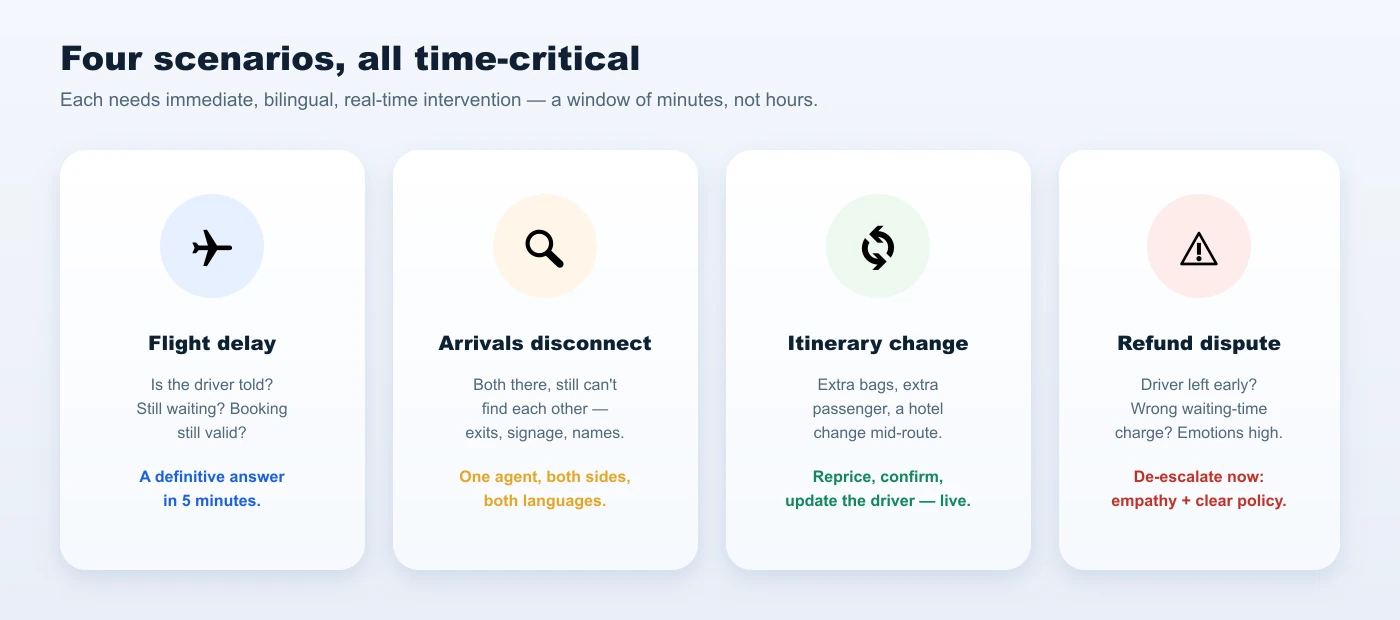
- Flight delay confirmation. A flight lands 45 minutes late. The passenger doesn’t know whether the driver has been told, whether they’re still waiting, or whether the booking is still valid. They need a definitive answer in the next five minutes, not the next two hours.
- Arrivals hall disconnect. Passenger and driver are both in the right place and still can’t find each other — different exits, different signage interpretations, a name board the passenger doesn’t recognize. Someone who can communicate with both sides simultaneously, in both languages, is the fastest path to resolution.
- Itinerary changes at short notice. Extra bags. An additional passenger. A hotel change that requires a route adjustment. These need an agent who can process the change, communicate the price difference, get confirmation, and update the driver — in real time, while the passenger is still deciding.
- Cancellation and refund disputes. A passenger who missed their transfer because the driver left before the grace period, or who believes they were charged incorrectly for waiting time, is not calm when they contact support. What de-escalates this is immediate, empathetic, in the passenger’s language, with a clear policy explanation and a specific resolution — not a template acknowledgment that someone will look into it.
What Platform A built — and what changed
Platform A operates cross-border airport transfers across European, North American, and Japan/Korea markets. When they engaged Callnovo, two problems were measurably damaging the operation: response times during peak hours were creating complaint escalations that faster intervention would have prevented, and passenger data — names, flight numbers, routes, contact details — was flowing through support interactions in ways that created data-protection exposure they hadn’t fully addressed.
7×24 multilingual coverage across all active markets
Callnovo deployed a multilingual team covering English, Spanish, French, and Japanese. Every agent went through specialized training in airport transfer scenarios — not generic customer service applied to travel, but specific protocols for the flight delay, arrivals disconnect, and real-time itinerary change situations.
When a passenger in Madrid’s Barajas airport can’t locate their driver, a Spanish-speaking agent coordinates simultaneously with the passenger and the driver — two calls, two languages, one resolution — and the passenger is in the vehicle within seven minutes of first contact. That requires someone who speaks both languages, knows the airport’s terminal layout well enough to give useful directions, and has the authority to make coordination decisions in real time without escalating to a manager.
Flexible summer scaling — deployed 15 to 25 days before peak season
For the July–September peak, Platform A needed a team that could absorb far higher contact volume without degrading response quality. Callnovo activated additional multilingual capacity 15 to 25 days before peak season — enough lead time to complete training on Platform A’s specific protocols and KPIs before the first surge.
After peak season, the team scaled back down. Platform A reduced headcount by 35% compared to its previous approach of carrying full peak-season staffing year-round. The savings came from elastic capacity rather than permanent staffing sized for the busiest weeks of the year.
Quantified KPIs — measured per time zone and language group
Platform A’s operation now runs against quantified targets — first response time, first-contact resolution, escalation rate, and CSAT — tracked separately for each language group and time-zone window, visible in real time, with enforcement mechanisms rather than aspirational guidelines.
For a multi-market platform, this means a response-time problem in the Japanese market is visible as a Japanese-market problem — not averaged into overall metrics where it stays invisible until it shows up in reviews. The granularity of the measurement is what makes the intervention specific.
The privacy risk that arrives without warning
Cross-border transfer support handles some of the most sensitive personal data in consumer travel: full names, passport information, flight numbers, hotel addresses, routes, and contact details. Agents access this as a routine part of every interaction.
Under applicable data-protection law, the obligations attached to this data don’t disappear because it was collected for a legitimate purpose. A passenger who, mid-call, says “please delete all my personal information” or “are you going to share my itinerary with anyone?” has triggered a formal data-deletion (privacy) request under applicable data-protection law — whether or not they use the regulatory language. How that moment is handled decides whether the platform has a compliance process or a compliance incident.
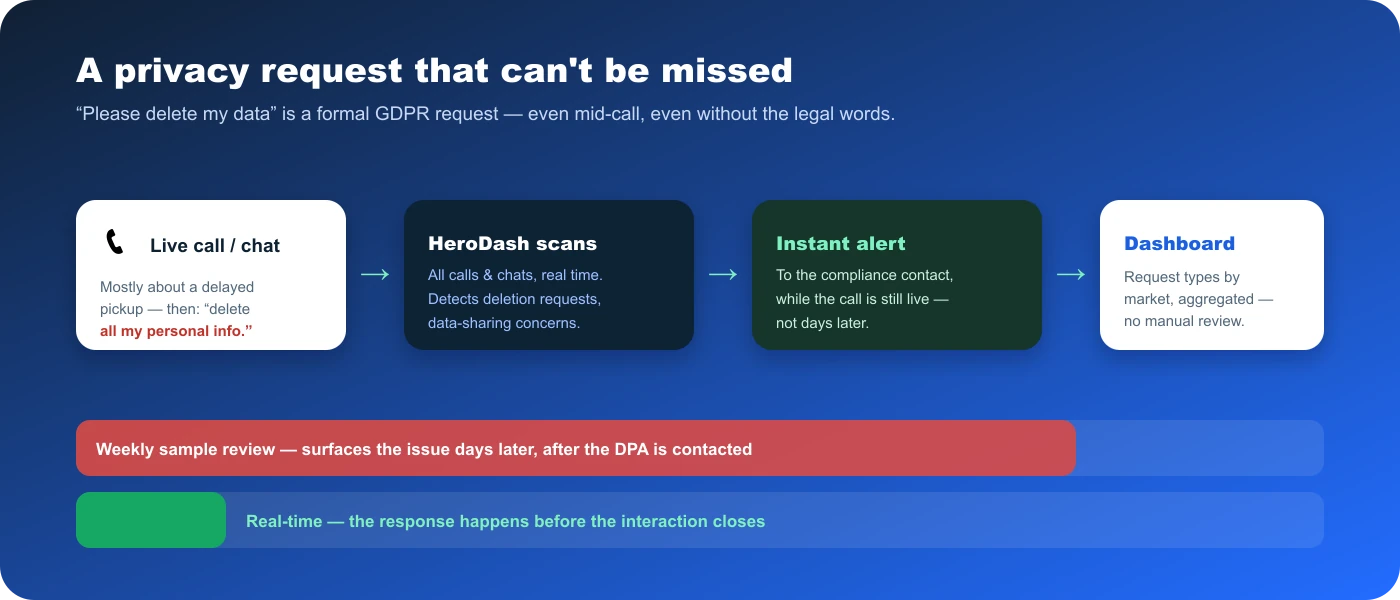
Traditional quality monitoring — periodic manual review of a sample — doesn’t catch these moments reliably. They happen in the middle of calls that are primarily about operational issues, and they’re easy to miss unless someone is listening specifically for them.
HeroDash’s privacy risk monitoring runs differently. The system scans all phone and chat interactions in real time, identifying semantic patterns that indicate a formal data-deletion or privacy request under applicable data-protection law — deletion requests, concern about data sharing, references to privacy complaints or regulatory bodies. When a trigger is detected, an alert is generated immediately and sent to Platform A’s designated compliance contact — while the call is still in progress, or within seconds of it ending, rather than in a weekly review that surfaces the issue days later. Aggregated request data feeds a dashboard that categorizes request types across all markets, so Platform A sees the distribution and frequency of privacy interactions without reviewing individual recordings manually.
Three operational changes that reduce disputes before support gets involved
The support infrastructure handles what reaches the queue. Some of what reaches the queue doesn’t have to.
Pre-arrival verification
Before the travel date, proactively confirm arrival terminal, flight number, baggage count, and the contact number the passenger will use on landing. Two minutes of confirmation prevents a forty-minute arrivals-disconnect call.
Transparent policy
Make the cancellation and waiting-time policy clearly visible at booking and restate it in the pre-travel confirmation. Most refund disputes are really disputes about a policy the passenger didn’t fully understand when they booked.
Differentiated B2B process
Give corporate and travel-agency accounts bulk itinerary management, consolidated invoicing, and dedicated modification channels — instead of routing a 50-transfer-a-month account through the individual-booking flow.
What cross-border transfer platforms should have in place before peak season ends
The July–September window is already running. Platforms without multilingual real-time coverage are already generating complaints a better infrastructure would have prevented. Three capabilities determine whether summer performance holds or degrades:
- Real-time bilingual coordination. Not a team that can respond to tickets in multiple languages, but agents who can talk to a passenger and a driver simultaneously in two languages to resolve a live situation — with native fluency, local airport knowledge, and the authority to decide without escalation.
- Elastic staffing that deploys before the peak, not during it. Agents trained and operational before the surge are useful. Agents recruited and deployed in response to a surge already underway are too late to prevent the complaints it’s generating.
- Privacy detection that’s real-time, not retrospective. For a service handling passport information, flight routes, and hotel addresses, data-protection compliance isn’t a documentation exercise — it’s an operational requirement, and the interactions that create risk don’t announce themselves in advance.
The passenger who lands and can’t find their driver is not yet a complaint. They’re a customer with a problem, in a moment of anxiety, who needs someone to answer in their language and resolve the situation before they reach for the review app. That 90-second window is where the platform’s reputation is won or lost — not in the quality of the vehicle or the price of the booking.
FAQ
Why do most airport transfer complaints come from communication, not the vehicle?
In the cross-border transfer operations Callnovo supports, close to 90% of disputes start at the handover — the moment a tired passenger walks out of arrivals and can’t find their driver, often across a language barrier and after a flight delay nobody confirmed. The complaint isn’t a dirty vehicle or a slow route; it’s a communication gap at the passenger’s most anxious moment.
Why does airport transfer support need real-time bilingual coordination?
Because the problems are time-critical — a passenger who can’t find their driver has a window of minutes before the situation escalates to a one-star review. Resolution requires an agent who can talk to the passenger and the driver simultaneously, in both languages, with local airport knowledge and the authority to decide without escalating to a manager.
How does elastic peak-season staffing work?
Additional multilingual capacity is deployed 15 to 25 days before the July–September peak — enough lead time to train agents on the platform’s specific protocols and KPIs before the surge. After peak season the team scales back down, cutting headcount 35% versus carrying full peak staffing year-round.
How does real-time data-protection / privacy-request monitoring work in transfer support?
HeroDash scans every call and chat in real time for semantic patterns that signal a formal data-deletion or privacy request under applicable data-protection law — asking to delete personal data, concern about data sharing, references to privacy complaints. When a trigger is detected, an alert reaches the compliance contact while the call is still in progress, not in a weekly review days later.