Key Takeaways
- Twilio is repositioning from a communications API company to the intelligent middleware layer for customer engagement — The “One Twilio” vision unifies CPaaS, CDP, and AI into a single platform.
- ConversationRelay (now GA) lets developers build voice AI agents with their own LLM — This removes months of infrastructure work for teams building custom voice experiences.
- The AI vs. human debate is the wrong frame for customer service — Every serious player is moving toward hybrid architectures that intelligently route between AI and human agents.
- Context is the new competitive moat — Companies that act on real-time customer data will deliver fundamentally better experiences, making generic chatbots and scripted IVR obsolete.
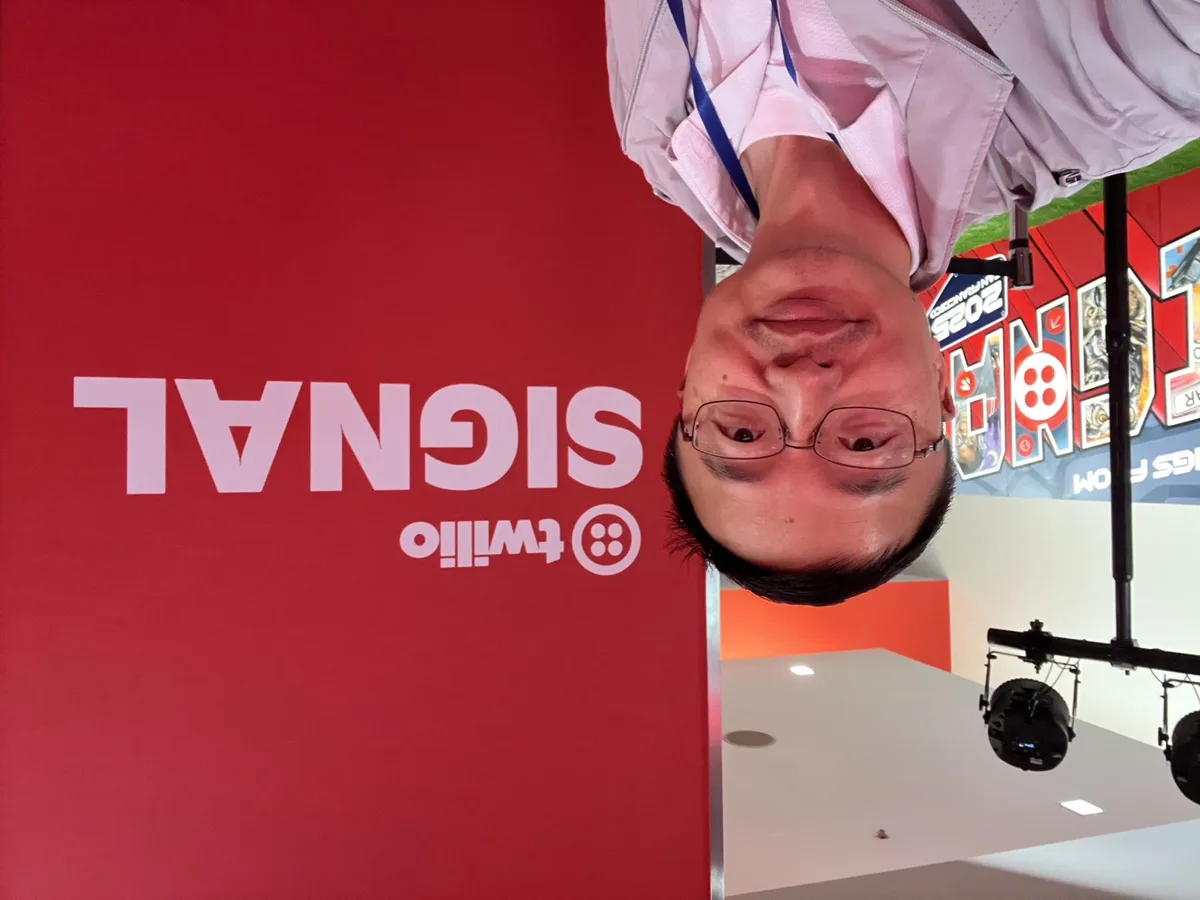
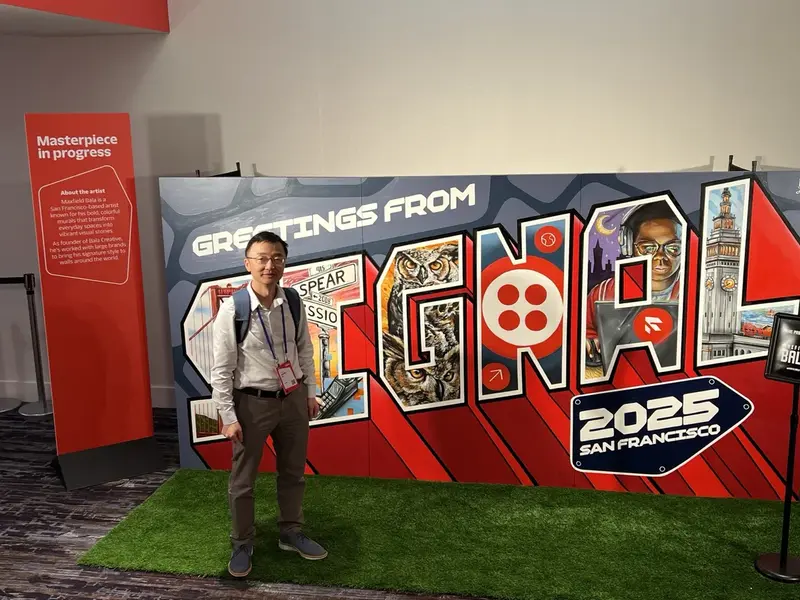
Last May, I walked into the Marriott Marquis in San Francisco for Twilio Signal 2025. It was the first time Signal had returned to the US since 2019 — over 100 sessions, thousands of developers and business leaders, and an energy that made it clear: the communications infrastructure we’ve relied on for a decade is being rewritten by AI.
As someone building AI-powered customer engagement at Callnovo, I didn’t go just to listen. I went to pressure-test our own thinking against the people defining the next layer of the communications stack. Nine months later, with Signal 2026 around the corner, here’s what stuck with me — and what I’m watching for next.
The Keynote That Shifted My Thinking
Khozema Shipchandler opened the main stage with a line that landed hard:
We are facing the end of customer experience as we know it.
Khozema Shipchandler, CEO, Twilio — Signal 2025 Keynote
Coming from the CEO of a company that powers communications for over 10 million developers, this wasn’t hype. It was a strategic declaration. Twilio’s “One Twilio” vision reorganized the entire platform around three pillars — trust, simplicity, and intelligence — signaling a move from being a communications API company to becoming the intelligent middleware layer for customer engagement.
The highlight was the fireside chat with Satya Nadella. The announcement of a multi-year Twilio-Microsoft partnership — integrating Twilio’s platform with Azure AI Foundry — was the clearest signal yet that conversational AI isn’t a feature. It’s the platform. When Twilio and Microsoft jointly commit to enabling developers to build multimodal, cross-channel AI agents, that’s not a product launch. That’s the new baseline.
For us at Callnovo, this confirmed something we’d been betting on: the future of customer service isn’t choosing between AI and humans. It’s building the intelligent layer that connects them.
Meeting Khozema
One of the highlights of Signal was meeting Khozema Shipchandler in person.

What struck me about Khozema is his operator’s mindset. Before becoming CEO, he served as Twilio’s CFO, COO, and President of Communications — and before that, spent over two decades at GE across aviation, industrial IoT, and global operations. He’s not a founder-visionary type. He’s a builder who understands both the financial discipline and the operational complexity of scaling a platform company.
That combination — strategic clarity with operational rigor — was visible in everything at Signal. The product announcements weren’t scattered moonshots. They were precise, interconnected moves that showed a company executing on a coherent thesis.

The Products That Mattered Most
Three announcements stood out to me as particularly consequential:
ConversationRelay (now GA). This lets developers build voice AI agents using their own LLM — with real-time streaming, interruption handling, and expressive voices baked in. For anyone building custom voice experiences, this removes months of infrastructure work. We’ve been building our own voice agent stack at Callnovo, and ConversationRelay validated many of our architectural choices while showing us where Twilio’s infrastructure can accelerate what we’re doing.
Conversational Intelligence. Now GA for voice and in beta for messaging, this product turns raw conversations — phone calls, chats — into structured data and actionable insights. This is the missing piece for most companies trying to understand what’s actually happening in their customer interactions at scale. It’s not glamorous, but it’s transformative.
Compliance Toolkit (public beta). Regulations like the US Telephone Consumer Protection Act are a real operational burden. Having compliance tooling built into the communications layer — rather than bolted on — is the kind of practical, un-flashy move that separates infrastructure companies from feature companies.
Beyond individual products, the pattern was clear: Twilio is positioning itself as the convergence point of CPaaS, CDP, and AI. The platform isn’t just sending messages anymore. It’s understanding context, predicting intent, and orchestrating engagement across channels.
What This Means for AI-Powered Customer Service
At Callnovo, we operate at the intersection of AI voice agents and multilingual human support. Signal 2025 reinforced three convictions:
The “AI vs. human” debate is the wrong frame. Every serious player in customer engagement is moving toward hybrid architectures. AI handles the structured, repeatable, high-volume interactions. Humans handle the complex, emotional, high-stakes moments. The question isn’t which one wins — it’s how intelligently you route between them.
Context is the new competitive moat. With Twilio unifying communications data and customer data through its CDP integration, companies that can act on real-time context — who the customer is, what they’ve done, what they need right now — will deliver fundamentally better experiences. Generic chatbots and scripted IVR systems are already dead. They just don’t know it yet.
Multilingual is no longer optional. With RCS messaging, WhatsApp Business Calling, and omnichannel support expanding globally, the ability to engage customers in their language — through AI or human agents — is table stakes. This is where Callnovo’s 65+ language capability becomes a genuine differentiator, not just a marketing bullet point.
Signal 2026 — What I’m Watching For
Signal 2026 is set for May 6-7 at the Marriott Marquis again. I’ll be there.
Here’s what I’m hoping to see:
Deeper AI agent orchestration. ConversationRelay opened the door. I want to see how Twilio enables complex, multi-step AI agent workflows — agents that can hand off between voice, chat, and email while maintaining full context.
Real-time personalization at scale. The Twilio-Microsoft partnership should be producing real results by May. I want to see live demos of AI agents that don’t just respond, but anticipate — using CDP data to personalize every interaction in real time.
Compliance automation for global markets. The Compliance Toolkit is a strong start for the US. But companies operating across borders — like our clients — need automated compliance management for GDPR, PDPA, LGPD, and dozens of other regulatory frameworks. I want to see Twilio think globally here.
The honest conversation about AI replacing contact centers. It won’t. But the operating model for contact centers is changing fundamentally. I want to hear Twilio — and the industry — talk honestly about what AI augmentation actually looks like at scale, without the hype.
See You There
Signal is one of the few conferences where the product announcements actually change how you think about building. Last year shifted my roadmap. I expect this year to do the same.
If you’re attending Signal 2026 — come find us. We’ll be the ones asking hard questions about multilingual AI and the future of human-in-the-loop customer engagement.