Key Takeaways
- Email demand doesn’t keep business hours — but your team does. Every hour between a customer’s question and a useful answer is a window where they decide things without you.
- HeroDash Email AI replies in ~30 seconds, day or night. Two independent modes: Autopilot (AI sends) for nights and weekends, Copilot (AI drafts, agent approves) for active hours.
- It reads, queries live data, checks your knowledge base — then writes. Replies are built on real order and policy data, not keyword-matched templates.
- Every reply passes five checks before it sends. Facts, data leaks, prompt injection, language, and identity verification. Any failure routes to a human.

A customer in Germany emails at 11pm asking about a delayed package. Your team won’t see it for eight hours. HeroDash Email AI sees it in seconds — and by the time your team starts their day, that ticket is already closed.
That is what after-hours AI email support is for: answering customer email around the clock — accurately and safely — when no one on your team is awake to do it.
The inbox problem that doesn’t fix itself
Open your email queue on a Monday morning after a promotional weekend and you already know what’s there. Shipping status questions. Return requests. “Where is my order?” in four different languages. Basic product questions an agent could answer in thirty seconds — if an agent had been there at midnight Saturday when the emails arrived.
They weren’t. So the emails sat.
By the time your team logs in, some of those customers have already opened a dispute. Some have left a review. Some have bought from a competitor. The emails are still there, technically unread, but the outcomes they were attached to have already been decided.
This is the structural problem with email customer service: the demand doesn’t follow business hours, but the team does. Every hour between a customer’s question and a useful answer is a window where that customer is making decisions without the information they need.
Two modes, one switch
HeroDash Email AI runs in two modes that toggle independently — because the right mode depends on the time of day, not on a single setting you configure once and forget.

Autopilot — nights, weekends, holidays
Runs with no one on the team present. The AI reads incoming emails, queries live data, writes replies, and sends them. No human in the loop. This handles the 11pm package inquiry, the Saturday-midnight return request, and the public-holiday backlog — automatically, without waking anyone.Copilot — alongside your team
Runs during active hours. The AI reads each email and generates draft replies — typically several options — that the agent reviews and sends. Instead of writing from scratch, agents edit and approve, so the same person handles significantly more volume in the same shift.Two independent switches. Copilot for the day, Autopilot for nights and weekends. The transition is seamless for the customer — they never know which mode handled their email. They just notice that someone replied.
What the AI actually does with an email
This is where most email AI tools fall short. They match keywords to templates — they find “return” in the subject line and fire back a returns-policy paragraph. The customer’s actual question (whether they could exchange a size rather than return the item) goes unanswered.
HeroDash Email AI works differently. Before writing a single word, the system does this:
Read only what's new
It strips out the signature, the quoted history from previous exchanges, and any boilerplate — and reads only what the customer actually wrote this time.Pull thread context
It looks at the last ten emails in the ticket thread, so a follow-up to a conversation from three days ago is treated as part of that history, not a brand-new inquiry.Query live data
Up to five tool calls per email, executed in sequence — order status, shipping tracking, payment and refund state, purchase history, product information. The reply is built on live data, not guesses.Check the knowledge base
Your catalog, return and exchange policies, FAQ, and shipping timelines are bound to the AI, so replies stay within what’s true for your business. It checks what your policy actually says — it doesn’t invent a return window.Write the response
Only after all of that does it write — grounded in this customer’s real order and your real policy.65+ languages, zero configuration
A customer emails in Spanish. The reply goes back in Spanish. German, French, Arabic, Portuguese — the system detects the language of the incoming email and responds in kind, automatically.
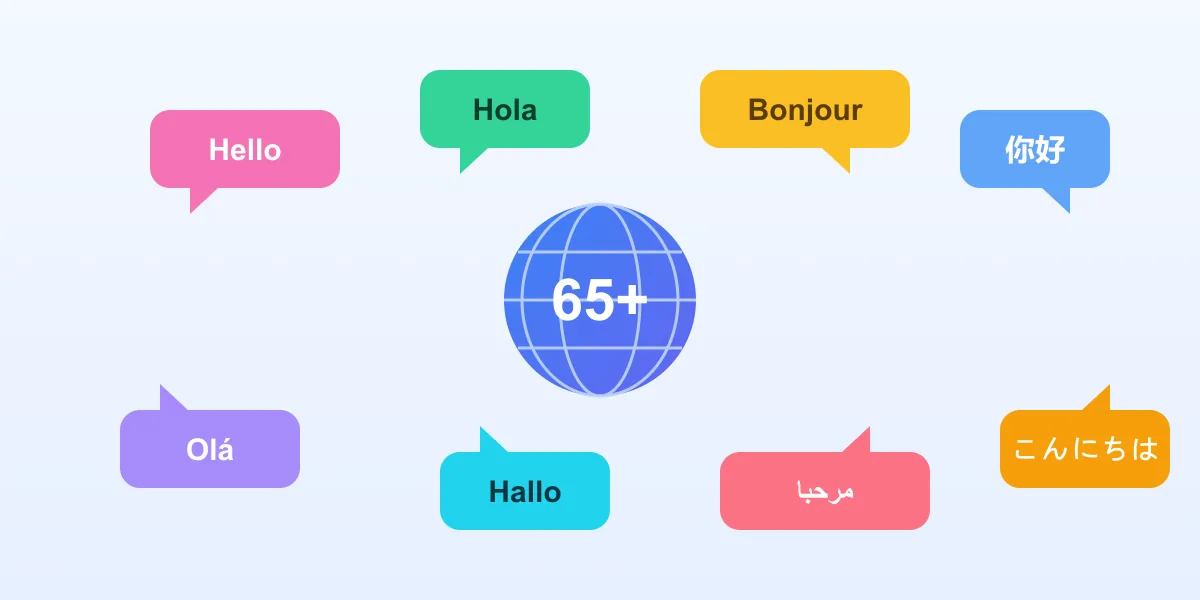
The knowledge base can be written in English or any other primary language, and HeroDash generates accurate replies in any of the 65+ supported languages from that single source. You don’t need a separate FAQ for each market. You don’t need to hire a Dutch-speaking agent to handle Dutch-language returns. The same knowledge base powers every language.
For brands running across multiple markets, this removes one of the most persistent staffing constraints in cross-border ecommerce: needing native speakers available at all hours, for every language your customers write in. (It’s the same multilingual engine behind our managed multilingual support.)
Before any email sends, it passes five checks
Automated replies carry real risk. A wrong price. An incorrect return window. One customer’s order details sent to another person. These aren’t hypothetical — they’re the specific reasons most operations teams hesitate to let AI send email without review.
HeroDash addresses this with a second AI layer that reviews every outbound reply before it sends. Five checks, in sequence, no exceptions:
Facts must match the knowledge base
If the reply states a price, it has to match your catalog. If it describes a return policy, it has to match what you defined. Anything that can’t be verified against a source doesn’t make it into the reply.No internal information leaks
System prompts, internal operational details, other customers’ information — none of it appears in an outbound reply.Prompt-injection attacks are blocked
Some emails contain instructions designed to manipulate AI systems. The review layer catches these and routes the email to a human instead of following the injected instruction.Language must match
If the customer wrote in French, the reply must be in French. A language mismatch at review stops the send.Data access requires verification
If the reply includes order-specific details, the system checks the customer’s identity was verified first. Unverified requests get a reply asking for verification — not an order summary.Any check that fails stops the email. The ticket routes to a human agent with a summary of what the AI drafted and why it was flagged. The agent makes the call. Nothing sends automatically when the review layer isn’t satisfied — and if anything in the processing chain breaks, the default is human escalation, not a partial reply or silence.
When AI steps aside
Automated replies are right for most emails. They’re wrong for some — and HeroDash Email AI knows the difference.

A customer who explicitly asks for a person gets a person. A complaint with genuine distress or a legal threat — not just a frustrated tone — goes to a human. Emails with attachments that need review. Accounts flagged for unusual activity. Any case where the AI’s confidence falls below the threshold set for that account.
When the handoff happens, the agent receives the full thread, the AI’s draft, and the reason it was flagged. They’re not starting from scratch — they’re reviewing a situation already partly worked through, with context ready to act on.
And every email’s final status is logged — sent automatically, sent after review, routed to agent, or skipped with a reason code. The audit trail is complete, queryable, and exportable. If a customer ever disputes what they received, the record is there.
Four security behaviors that run on every email
Beyond the five-check review layer, four behaviors run automatically on every email processed:
The isolation is structural, not just a permission setting. The AI works with the underlying data but never surfaces sensitive values in outbound text.
From 12 hours to 30 seconds
Across a full inbox, average first response time often runs around 12 hours — an overnight email like our 11pm package inquiry might wait eight, a post-promotion Monday backlog far longer. Cutting the average to ~30 seconds isn’t a marginal improvement. It’s a fundamentally different customer experience.
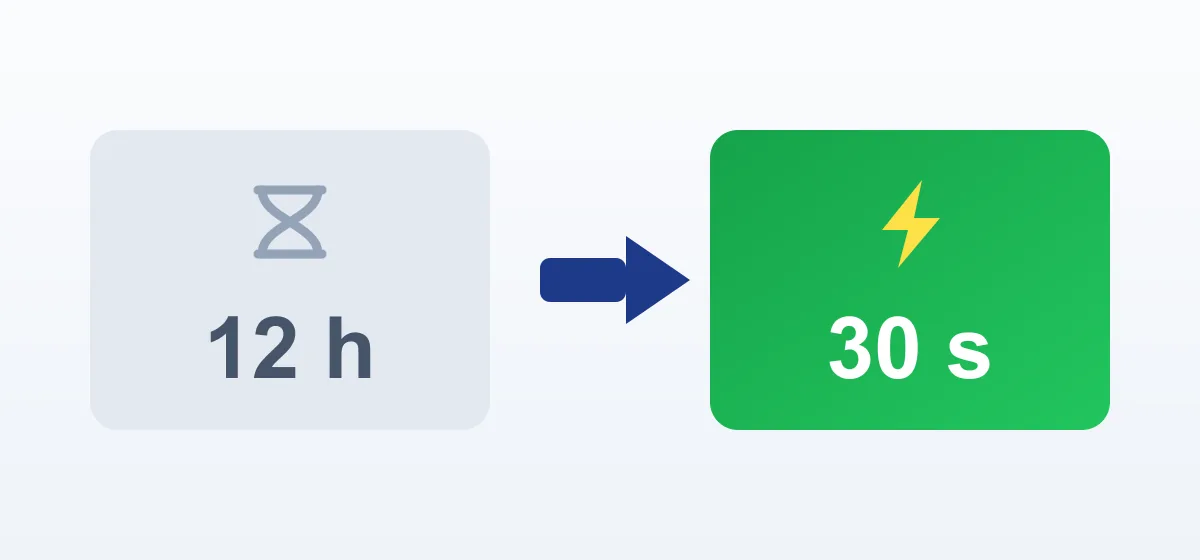
At a 12-hour average, a customer who emailed overnight has been waiting since last night. They woke up, checked their email, saw nothing, and have already decided what they think of your reliability. Some have opened a dispute or left a review. The 9am response is damage control.
At 30 seconds, that same customer has a reply before they’ve closed the email app. It tells them where the package actually is, the updated delivery estimate, and what to do if it doesn’t arrive by then. They go to sleep knowing the question was answered. No dispute. No review. No decision made in the absence of information.
The 30-second response doesn’t just lift satisfaction scores. It intercepts decisions that would otherwise be made without your input — and in ecommerce, those decisions are often permanent. During promotional periods and major events, when volume multiplies and the gap between incoming mail and available agents widens, that interception value compounds. The economics of speed are well documented: Harvard Business Review found that firms responding within an hour were nearly 7× more likely to qualify a lead than those that waited even one hour longer — and a customer waiting on an order answer is making the same kind of fast judgment about your brand.
FAQ
Can AI safely send customer service emails without human review?
Yes — when it’s bounded correctly. HeroDash Email AI runs every drafted reply through five automatic checks before sending: facts must match the knowledge base, no internal information can leak, prompt-injection attempts are blocked, the language must match the customer’s, and any order-specific details require identity verification. If any check fails, the email routes to a human agent instead of sending.
What is the difference between Autopilot and Copilot mode?
Autopilot runs with no human present — the AI reads, queries live data, writes, and sends automatically, ideal for nights, weekends, and holidays. Copilot runs alongside your team during active hours — the AI drafts replies an agent reviews and approves, so each agent handles far more volume. The two modes are independent switches, and the transition is invisible to the customer.
How many languages does HeroDash Email AI support?
65+ languages with zero extra configuration. The system detects the language of each incoming email and replies in the same language, all generated from a single knowledge base written in your primary language. You don’t need a separate FAQ or a native-speaking agent for each market.
How does the AI avoid sending wrong prices or policies?
Before writing, the AI queries live data (order, shipping, payment, purchase history) and binds to your knowledge base (catalog, return and exchange policies, FAQ). A second AI review layer then verifies every factual claim against a source. Anything that can’t be verified doesn’t make it into the reply.
What happens when the AI isn’t confident about an email?
It steps aside. Requests for a person, genuine complaints or legal threats, emails with attachments, flagged accounts, or anything below the confidence threshold route to a human agent — who receives the full thread, the AI’s draft, and the reason it was flagged. System failures default to human escalation, never a partial or silent reply.
About Callnovo & HeroDash
Callnovo is a global multilingual customer support partner. HeroDash is its unified support platform, pairing AI automation with human agents across email, chat, and voice in 65+ languages. HeroDash Email AI is the email layer of that platform — built so that after-hours coverage doesn’t mean unanswered inboxes, and automation doesn’t mean unsafe replies.
Want to see HeroDash Email AI handling your actual email queue? Explore the HeroDash platform, see how multilingual support and managed teams fit together, or talk to our team about what deployment looks like for your email volume and markets.
Sources
- Zendesk Customer Experience Trends Report
- Harvard Business Review — The Short Life of Online Sales Leads