Key Takeaways
- Shared customer service is best for repeatable inquiries. It works when most questions can be answered from a standard playbook.
- Dedicated agents become necessary when complexity rises. Technical products, judgment-heavy questions, and brand-sensitive interactions need deeper training.
- Volume is not the only trigger. The real trigger is whether the customer needs an answer that a generalist pool cannot safely give.
- Most growing sellers do not need to choose forever. Shared support can validate demand, then dedicated support can take over once the operating pattern is clear.

Most sellers ask about shared versus dedicated support a little late.
By the time the question feels urgent, the queue is already bending: response time is stretching, a few messages are being missed, and the founder is quietly back inside the inbox after dinner.
And the cost is not abstract. Zendesk’s CX research has found that the majority of customers will walk away from a brand after more than one bad support experience. For a technical product, the first vague answer is often the last conversation you get.
The usual instinct is to solve the problem by volume. Twenty inquiries a day means shared support. Fifty means dedicated. That sounds tidy, but it misses the real decision point.
The better question is this: can a trained generalist answer the question safely, or does the customer need product-specific judgment?
Quick Answer
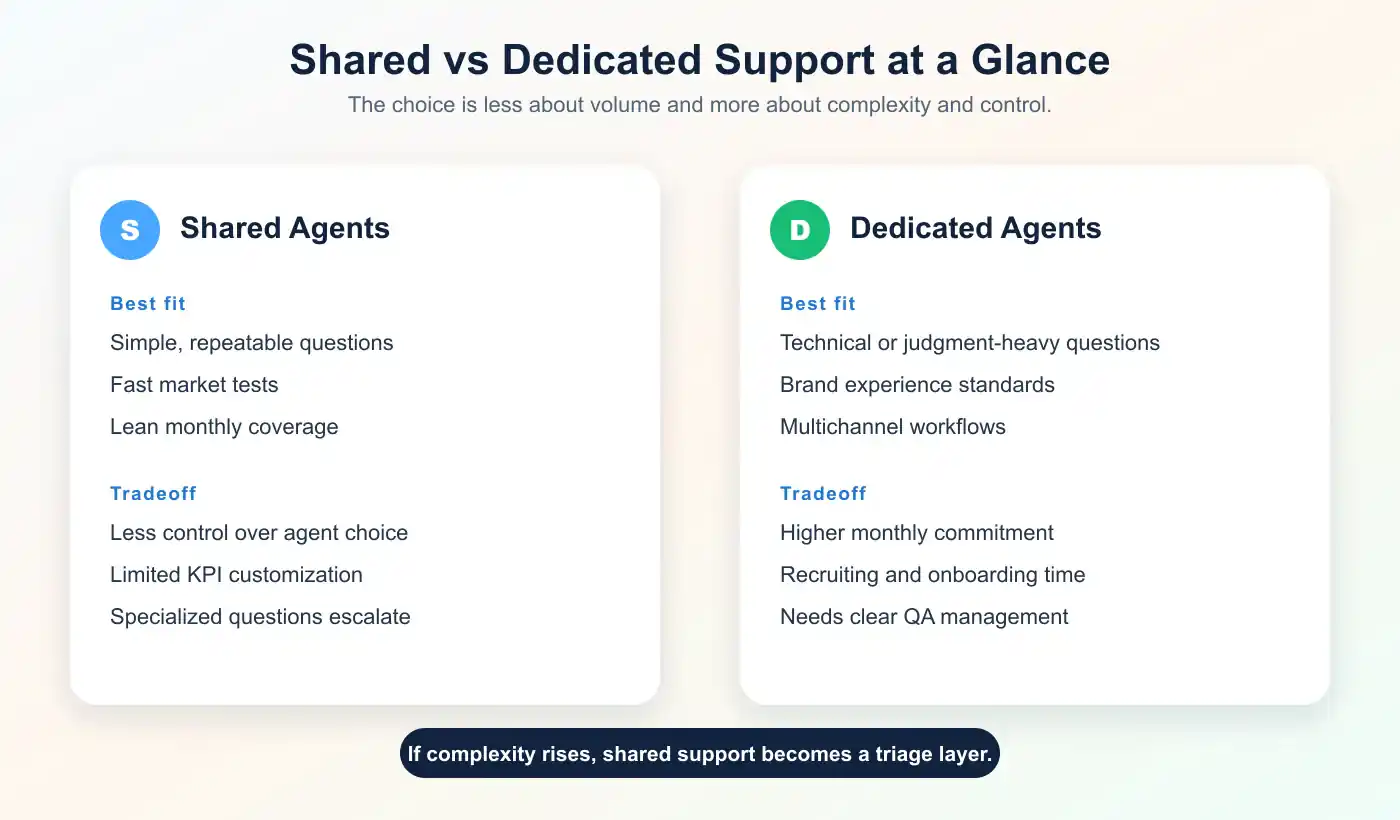
Shared support is a smart starting point when the work is standardized. Dedicated support is the right move when the answer quality needs to be controlled.
| Choose shared support when… | Choose dedicated support when… |
|---|---|
| Most contacts are order status, shipping, returns, and simple product questions. | Customers ask technical, configuration, warranty, or compatibility questions. |
| You are testing a new market or seasonal campaign. | Reviews, repeat purchase, or safety depend on the quality of the answer. |
| You need fast coverage and a lean monthly cost. | You need to interview the agent, customize KPIs, and enforce standards. |
| The brand voice can be handled from a short playbook. | The agent needs to sound like part of your brand, not a generic help desk. |
Not sure where your queue sits? Talk to Callnovo, and we can map shared, dedicated, or hybrid coverage against your actual inquiry mix.
The 3-day shared launch path and roughly 2-week dedicated recruiting path reflect typical Callnovo onboarding ranges for standard support scopes. Complex products, rare languages, and multi-channel requirements may take longer.
What Shared Customer Service Actually Gives You
Shared customer service runs on a resource pool model. One agent may handle contacts for several brands during the same operating window. You pay less because the coverage cost is distributed.
That is not a flaw. It is the product.
For a growing ecommerce seller, shared support can be exactly right:
- fast deployment, often within a few days
- predictable monthly cost
- coverage for routine inbound questions
- a low-risk way to learn what your support queue actually contains
The tradeoff is control. You usually do not interview the agent, build deep product training, or customize every KPI. Channel coverage may also be narrower than a dedicated setup.
In a shared model, the question is not “can this agent care?” A good shared agent can care a lot. The question is whether the model gives that agent enough context and authority to answer the questions your customers are asking.
What Dedicated Customer Service Changes
A dedicated agent works only for your brand. Every hour, every customer, every workflow, and every coaching conversation belongs to your operation.
That changes the management model.
With dedicated support, you can:
- participate in hiring and interview candidates
- train on your products, policies, edge cases, and brand tone
- cover more channels: phone, email, live chat, social, outbound follow-up
- set custom KPIs for response time, resolution rate, quality score, CSAT, and escalation accuracy
- coach the same person over time instead of retraining the queue repeatedly
The cost is higher. The recruiting cycle takes longer. If volume drops, the fixed commitment can feel heavier.
But the core value is not “more people.” It is control.
When a customer asks a question that can affect installation, safety, compatibility, or whether they trust the brand, the answer should not depend on whoever is available in a generalist pool.
The Solar Seller Who Found the Line
Lee sells solar panels into the North American market. At launch, his support volume was modest: about 15 contacts a day. Shared support made sense. It was live quickly, affordable, and good enough for the queue he had at the time.
For the first two months, the model worked.
Customers asked about shipping status, address changes, basic specs, and delivery timing. The shared team handled those contacts without much friction.
Then the inquiry mix changed.
Daily contacts climbed to about 28. That increase mattered, but it was not the main issue. The real change was the type of question customers were asking:
- “With a 30-degree roof pitch, how much will output decline in winter?”
- “What is the difference between half-cell and full-cell panels for my configuration?”
- “Will this setup work with my existing inverter?”
Those are not ordinary FAQ questions. They require product understanding, technical vocabulary, and a sense of what should be escalated.
The shared team started forwarding more questions back to Lee. He had outsourced support, but he was still answering the hardest questions himself. The only difference was that the questions arrived later.

The lesson generalizes: the trigger for dedicated support is rising answer complexity, not rising ticket volume.
Lee later described the decision clearly:
“I did not switch because volume went up. I switched because the complexity of the questions went up, and my need for control over the answers exceeded what the shared model could provide.”
He interviewed three candidates and selected one with an electrical engineering background. That agent was trained on solar panel technology, photovoltaic principles, configuration questions, and Lee’s support standards.
Technical inquiry resolution moved from 48% to 94% in the first full month after the dedicated agent took over. For this case, “technical inquiry resolution” means the share of logged technical questions resolved by the support team without Lee stepping in personally. The metric is a case-specific operating result, not a guaranteed outcome for every product category.
The Two Questions That Matter
The cleanest decision framework is short.
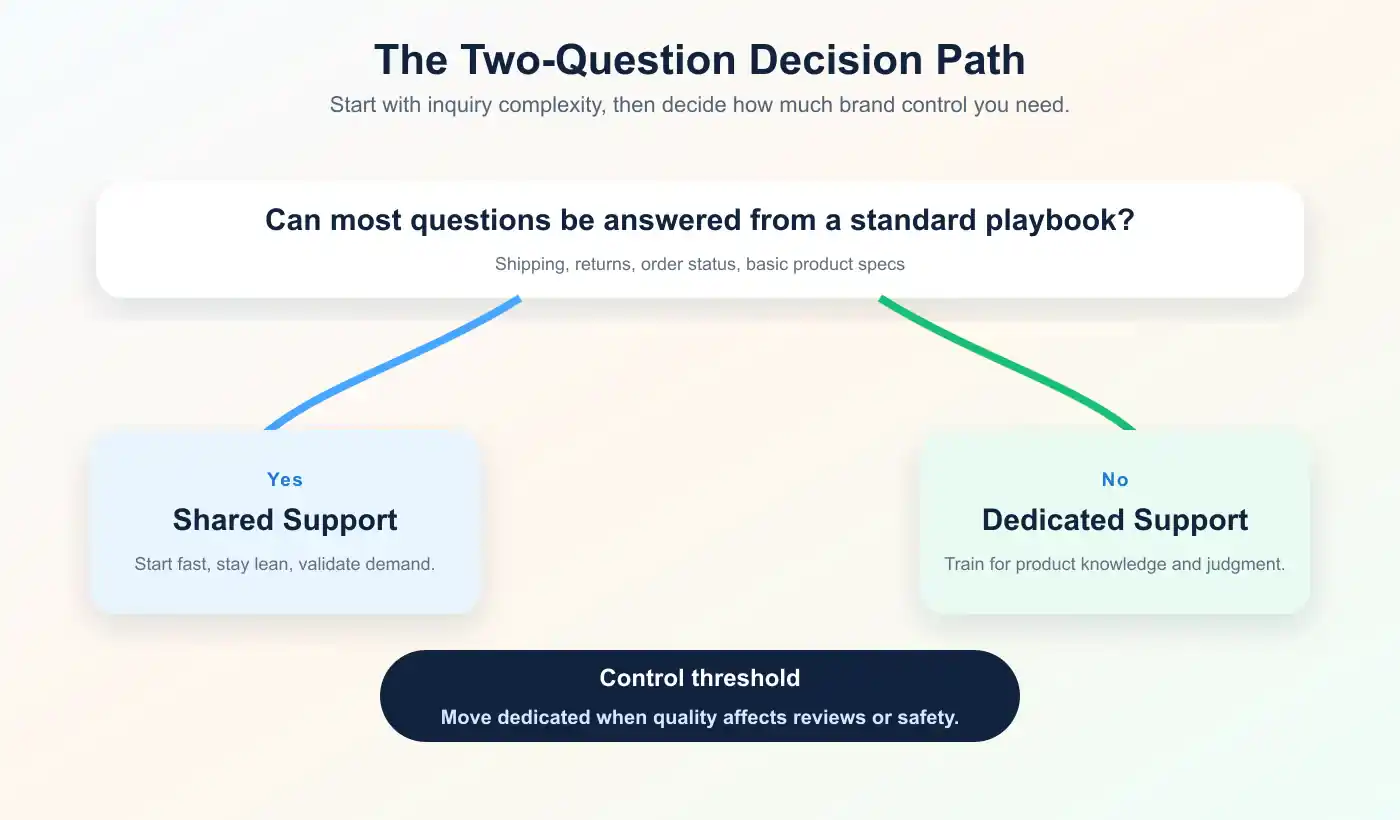
1. Can most inquiries be handled from a standard playbook?
If the answer is yes, shared support may be enough.
Good shared-support questions include:
- “Where is my order?”
- “Can I change my shipping address?”
- “What is your return policy?”
- “Do you sell this product in another color?”
- “Can you resend my tracking link?”
If your customers regularly ask “which configuration is right for me?” or “why is this device behaving this way?” the model is different. Those questions need diagnosis, not only responsiveness.
2. How much control do you need over the answer?
Some brands only need coverage. Other brands need a controlled experience.
If your category is simple and price-driven, a fast, polite, correct answer may be enough. If your category is technical, premium, regulated, or review-sensitive, answer quality becomes part of the product.
That is the moment dedicated support starts to make economic sense.
How Sellers Usually Move Between the Models
The path from shared to dedicated is usually a progression, not a dramatic switch.
Many brands start with shared support for one to two months. That period gives the operation real data:
- contact volume by day and channel
- repeat question types
- escalation rate
- common product confusion
- whether customers expect simple answers or expert guidance
If most contacts stay simple, shared support can remain the long-term model.
If escalation volume rises, the next step is structured:
- Define which inquiries should be resolved by the frontline agent.
- Build the product and policy training library.
- Recruit and interview dedicated candidates.
- Set KPIs for response time, resolution, CSAT, and escalation quality.
- Keep the shared model as overflow or after-hours coverage where useful.
This is where managed customer support, multilingual support, and HeroDash matter. A staffing model works better when the workflow, QA, and customer context are visible in the same operating system. As McKinsey notes in its work on AI-enabled customer service, the operating model increasingly shapes service quality as much as headcount does.
For ecommerce sellers still deciding what to outsource, the premium footwear support case shows how a dedicated team handles a complex catalog. For the same model run at global scale, the EZVIZ HeroDash case study shows why operating model design matters as much as headcount.
A Simple Buyer Checklist
Use this before you choose a plan.
| Question | If the answer is yes | Likely model |
|---|---|---|
| Can an FAQ resolve most contacts? | You mainly need coverage. | Shared |
| Are customers asking technical or use-case questions? | You need product judgment. | Dedicated |
| Do you need email, chat, social, phone, and outbound follow-up? | You need an integrated workflow. | Dedicated |
| Are you testing a market for 30 to 60 days? | You need speed and low commitment. | Shared |
| Does support quality shape reviews or repeat purchase? | You need measurable standards. | Dedicated |
| Is volume unpredictable but questions are simple? | You need flexible coverage. | Shared or hybrid |
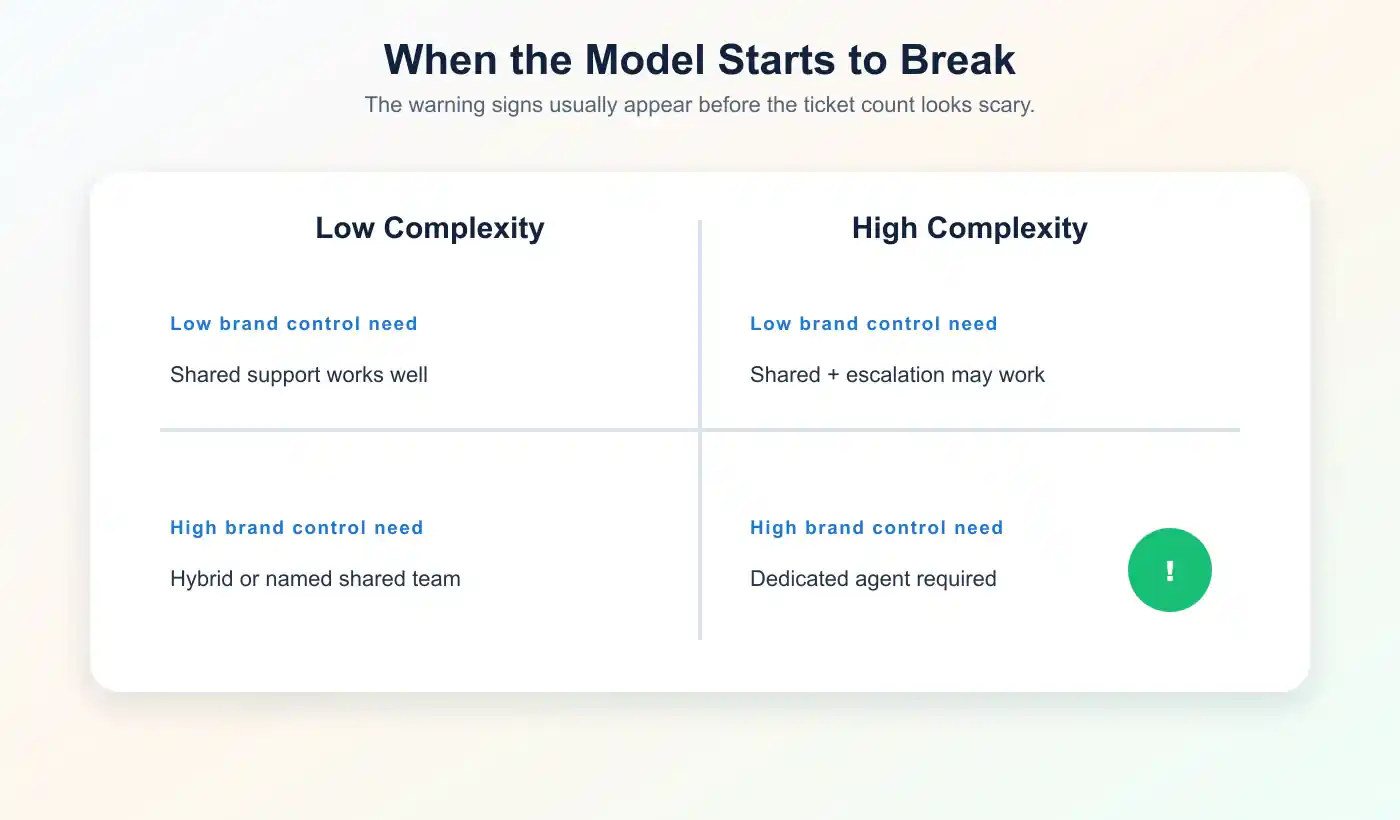
The right answer is not always one or the other. Some brands use dedicated support during peak hours and shared support for overflow. Others start shared, then move technical questions to a dedicated agent while leaving routine order status contacts in a shared pool.
The best model is the one that matches the work.
FAQ
What is the difference between shared and dedicated customer service agents?
Shared agents serve multiple brands from one support pool. Dedicated agents work exclusively for one brand. Shared support is faster and leaner; dedicated support gives more control, product knowledge, channel coverage, and KPI customization.
When should a business use shared customer service?
A business should use shared customer service when most inquiries are simple, repeatable, and answerable from a standard playbook. Typical examples include order status, shipping updates, returns, address changes, and basic product questions.
When should a business switch to dedicated support?
A business should switch to dedicated support when inquiry complexity rises, when customers need product-specific judgment, or when support quality affects reviews, repeat purchase, safety, or brand trust.
Is dedicated support always better than shared support?
No. Dedicated support gives more control, but it costs more and takes longer to recruit. Shared support can be the right long-term model for low-complexity products, early market tests, and lean ecommerce operations.
Sources
Case study details reflect a real Callnovo client experience. Client surname used with permission.