Key Takeaways
- World Cup demand behaves like pulse traffic, not a planned retail peak. A match, highlight, player moment, or social post can compress demand into a few hours.
- Response delay is more expensive when the purchase has a match deadline. If the answer comes after kickoff, the sale may already be gone.
- More agents alone does not solve unpredictable spikes. The support system needs unified channels, AI resolution, multilingual routing, and human escalation for emotional cases.
- The data from this tournament should improve the next event. Every spike reveals which products, markets, and inquiry types need better preparation.
Timing note: The FIFA World Cup is already underway, and the first week has already shown why ecommerce support cannot be planned like a normal retail calendar. This article uses the official FIFA match schedule as tournament context. Support recommendations are operational guidance, not a promise of identical results for every seller.
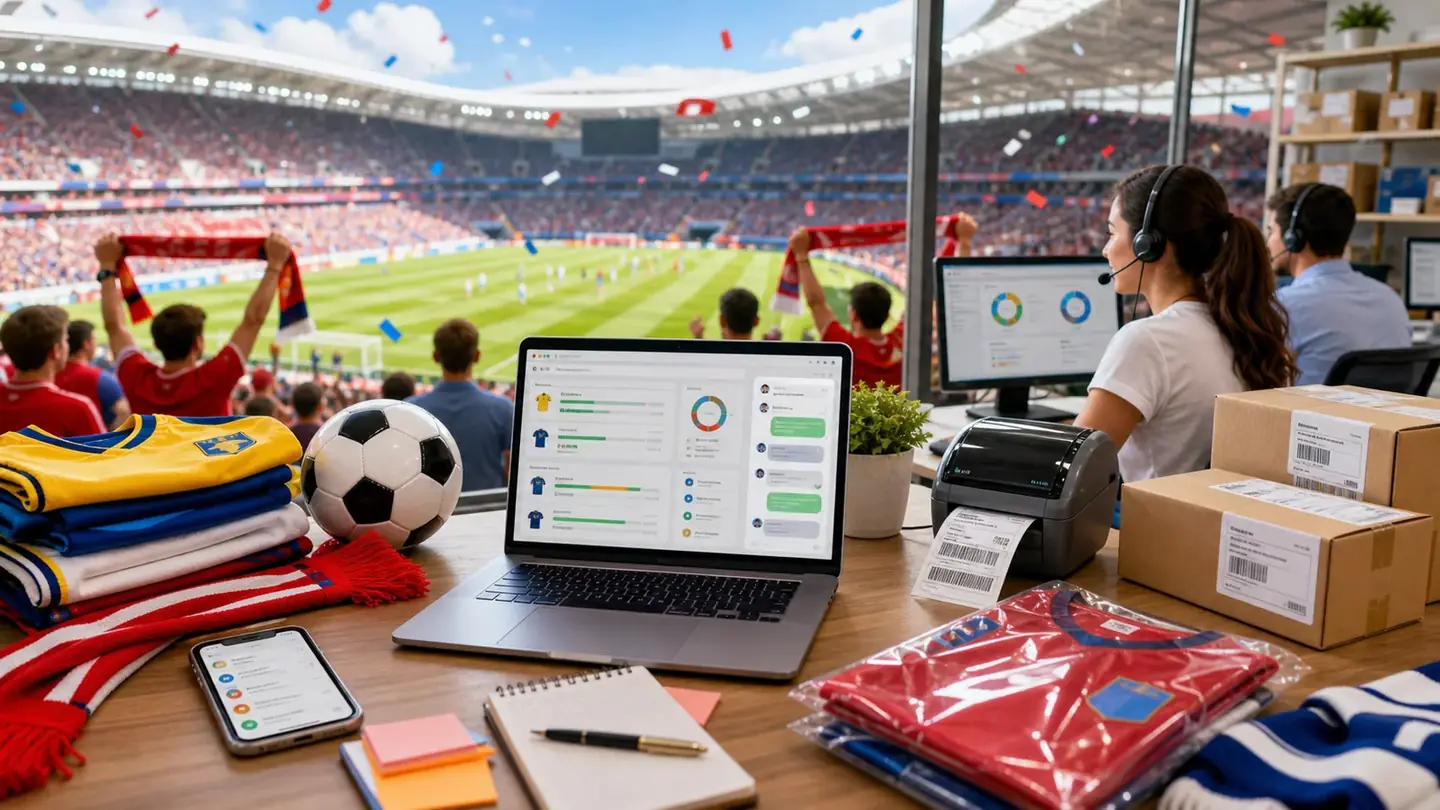
World Cup traffic does not behave like Prime Day.
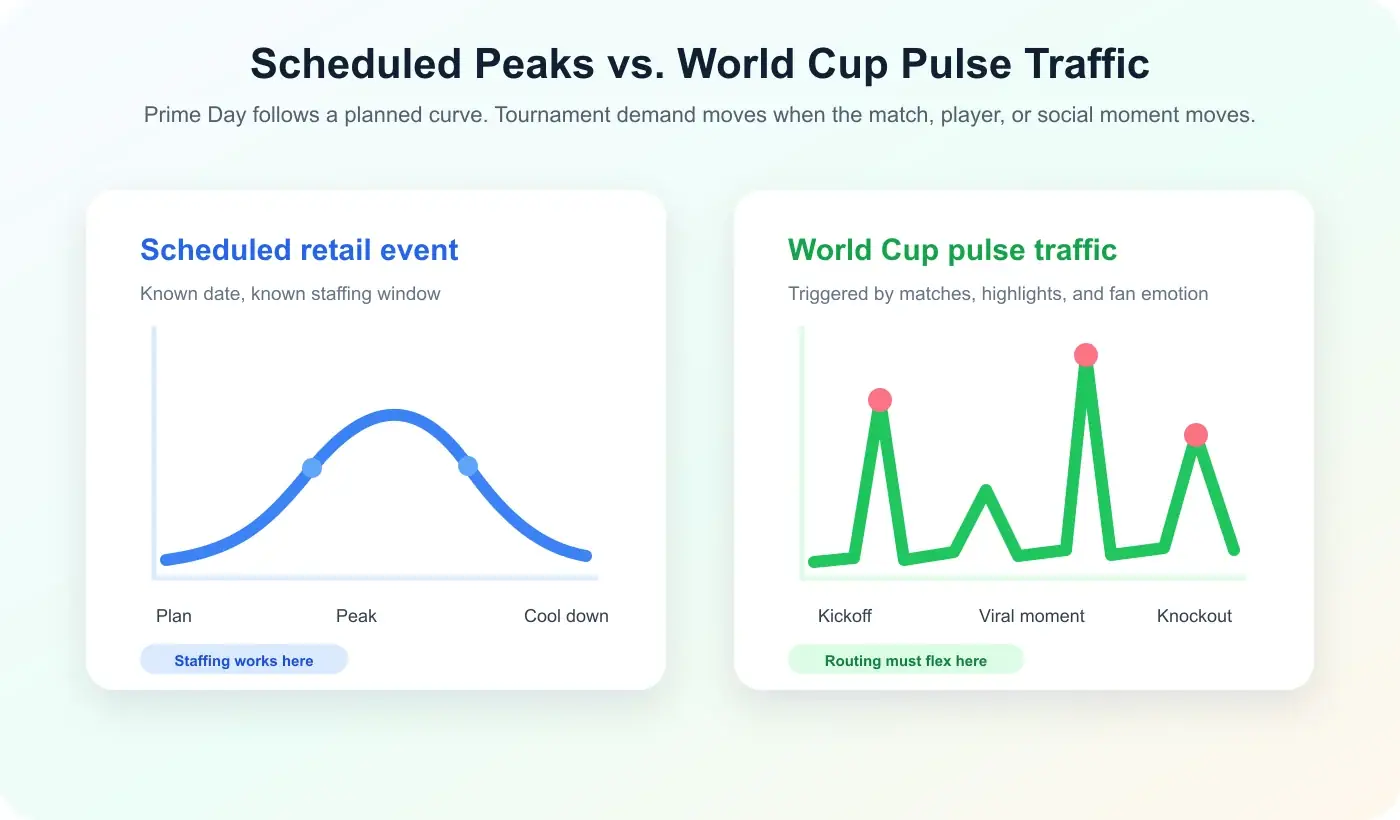
That sounds obvious until a support team tries to staff for it. Prime Day is a scheduled retail event. You know the dates, the discount structure, the campaign calendar, and the likely ramp. World Cup ecommerce support is different. It follows the scoreboard, the group chat, the highlight reel, and the emotional urgency of fans who want a product before the next match.
For sports brands, fan gear sellers, apparel brands, viewing-party suppliers, and ecommerce teams with tournament-adjacent products, this difference matters. The same support plan that works for a scheduled sale can fail during a month-long tournament because the pressure does not arrive as one smooth wave. It arrives in pulses.
Two Traffic Patterns, One Common Mistake
Most ecommerce teams are good at preparing for scheduled peaks. They have done holiday season, Black Friday, Cyber Monday, Prime Day, product drops, and influencer campaigns. They can plan rosters, temporary agents, macros, and warehouse coverage around known dates.
The World Cup creates a less polite pattern.
One player’s breakout performance can sell out a jersey color. One viral outfit can move a pair of sneakers or a jacket. One upset result can make a national-team item explode in a market that was quiet the day before. One clip on TikTok can turn a normal product question into a flood of comments, DMs, live chat messages, emails, and WhatsApp replies.
This is pulse traffic. It does not rise smoothly. It spikes suddenly, fades, and then spikes again when the next match or social moment arrives.
Where Tournament Support Breaks First
The first failure usually is not the warehouse. It is the answer.
During a normal shopping week, a two-hour response delay is bad. During a tournament, it can erase the reason the customer wanted the product. A fan asking “Can this arrive before Saturday’s match?” is not asking a casual shipping question. They are deciding whether to buy now, buy somewhere else, or give up because the event window is closing.
For fan gear, apparel, sneakers, flags, home viewing gear, party supplies, and accessories, the sales window may be measured in hours. Once the match starts, the urgency disappears. Support delay becomes lost demand, not just a slower customer experience.
The second failure is channel fragmentation.
World Cup purchase journeys often begin outside the store. A customer sees a highlight on TikTok, a jersey photo on Instagram, a recommendation in a WhatsApp group, or a link from a friend. The support questions then scatter across those same channels: a sizing comment, a DM about stock, a live chat about delivery, an email about an exchange, a WhatsApp message asking whether the order can still arrive in time.
If each channel has its own inbox, the team loses context. One customer may ask on Instagram, then live chat, then email. Without a unified view, the brand sees three tickets. The customer experiences one unresolved problem.
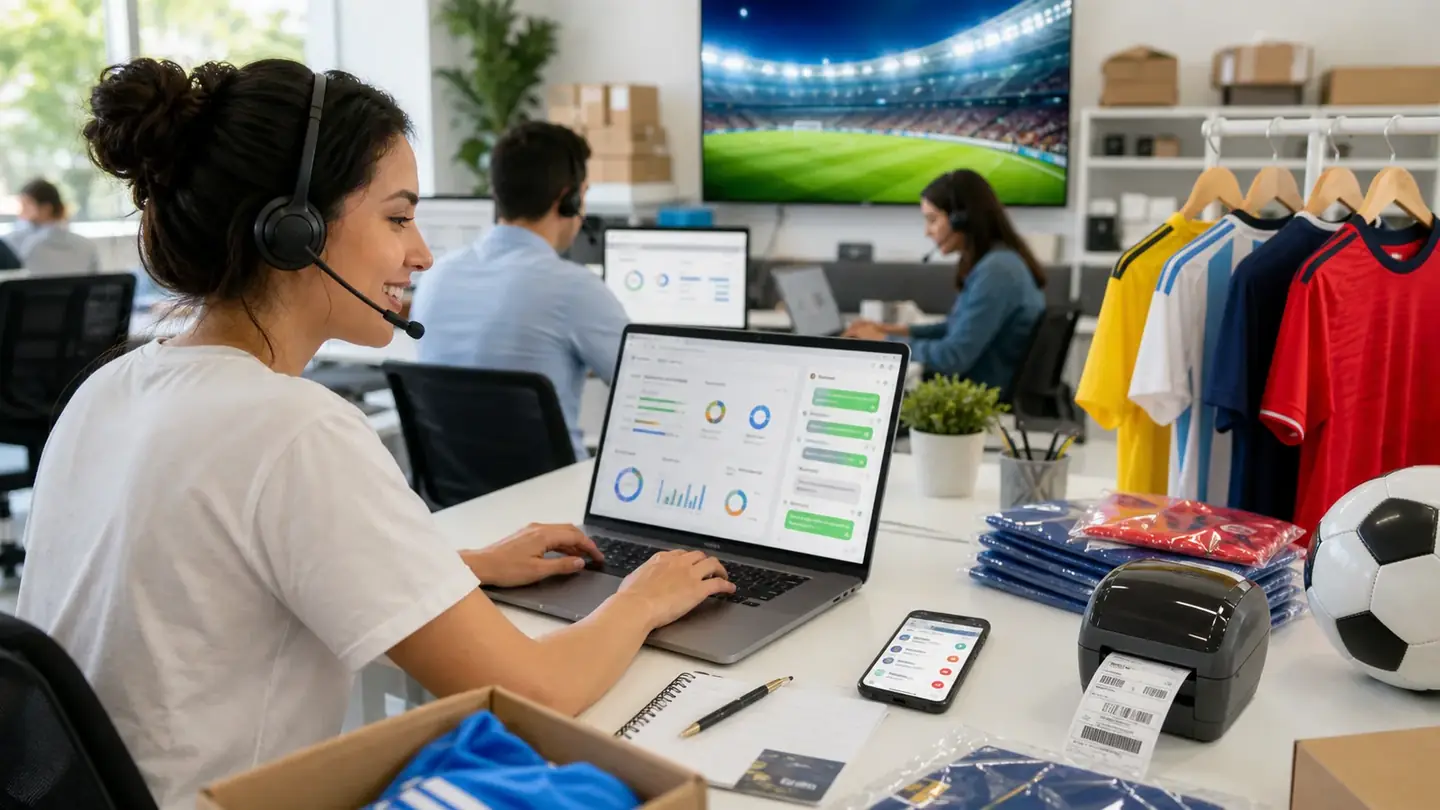
The third failure is emotional escalation.
A World Cup purchase is not always a normal ecommerce order. It may represent a team, a match-day ritual, a watch party, or a shared moment with family and friends. When the item is late, the customer is not only disappointed that a package missed a delivery estimate. They feel the event experience slipping away.
“My jersey has not arrived and the match already started” is not a complaint that improves with time. It needs a fast, specific, empathetic answer and a clear resolution path.
Why Adding More People Is Not Enough
The instinct is to add headcount: more agents, longer shifts, temporary coverage. That helps when the spike is predictable. It struggles when the spike can come from any match, any market, any product, and any social platform.
Staffing for an unpredictable pulse means paying for peak capacity during quiet hours and still risking undercoverage during the biggest moments. The problem becomes harder when sales cross language boundaries. North America, Europe, Latin America, and global fan communities may all create demand at different times and in different languages.
The better question is not “How many more agents do we need?”
The better question is: “Which contacts should reach a human at all, and which contacts should be resolved before a queue forms?”
For tournament traffic, the support system needs to do four things at once:
| Requirement | Why it matters during the World Cup | What breaks without it |
|---|---|---|
| Unified channels | Customers move between social, chat, email, and messaging apps | Duplicate tickets, missed context, inconsistent answers |
| Live product and order data | Fans ask about stock, size, delivery windows, and order status | Agents guess, delay, or send generic answers |
| AI resolution for routine contacts | Many questions are repetitive and deadline-driven | Human queues fill with contacts that do not need judgment |
| Human escalation by risk | Emotional complaints can become public fast | The most sensitive contacts wait behind simple questions |
What Event-Ready Support Looks Like
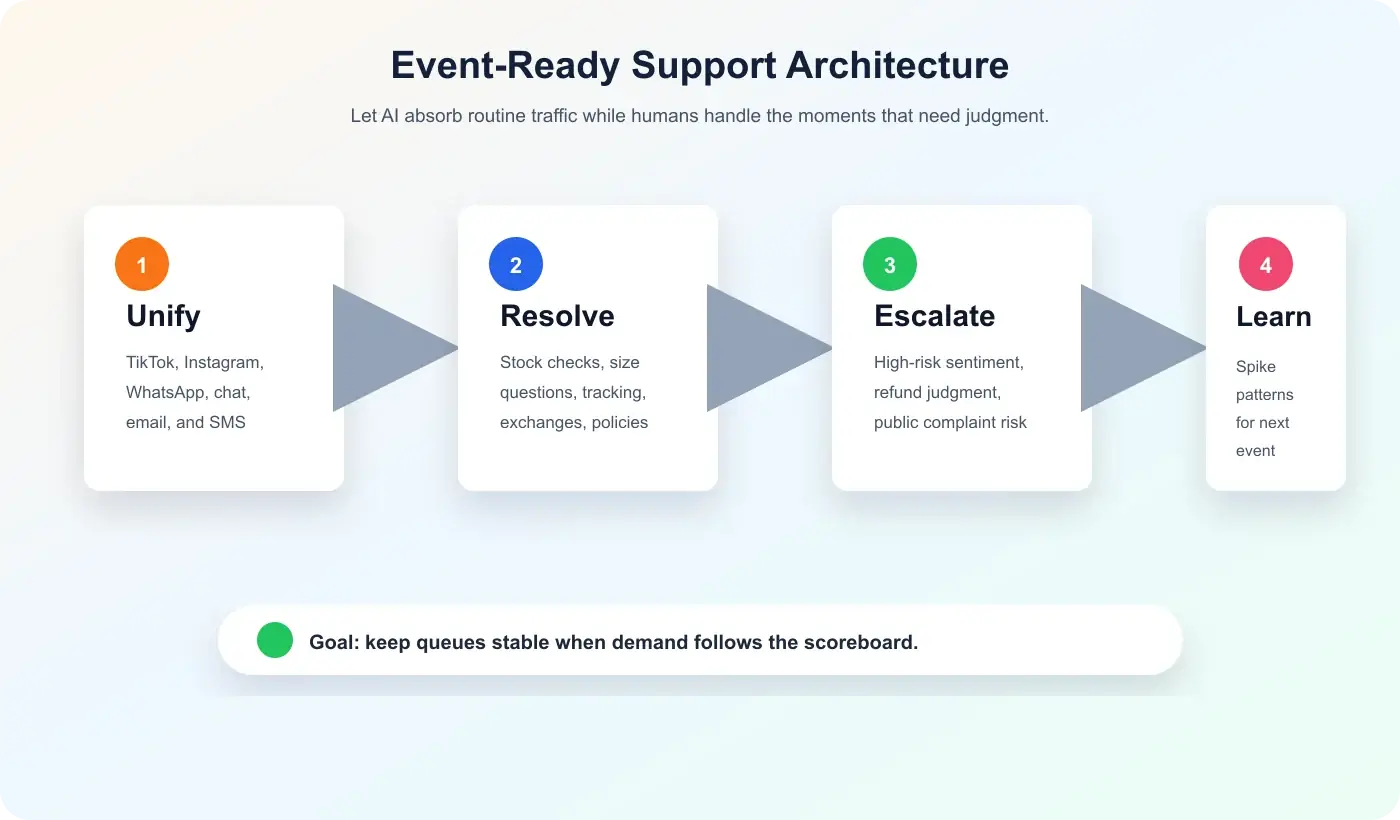
An event-ready support model starts by pulling channels into one workspace. TikTok comments, Instagram DMs, WhatsApp messages, live chat, email, and SMS should not behave like separate worlds. The customer has one problem. The team needs one view of it.
HeroDash is designed around that operational problem: unify the conversation, identify intent, retrieve the right knowledge, act where the workflow is structured, and route the right exceptions to people.
For a sports merchandise seller, the first layer is understanding. The system identifies whether the customer is asking about sizing, stock, delivery deadline, order status, exchange rules, refund eligibility, or a complaint. It should work across languages and channels, because tournament demand does not respect the language your staffing plan prefers.
The second layer is retrieval and reasoning. The answer should come from current product data, policy data, logistics data, and the brand’s approved tone. If a customer asks whether a jersey can arrive before a Friday match, the answer should not be a generic shipping policy. It should reflect the destination, cutoff time, carrier estimate, fulfillment status, and available shipping options.
The third layer is action. For structured contacts, AI can look up tracking, send a delivery link, explain a size chart, start an exchange flow, confirm stock, or collect the information needed for a human review. For structured AI-resolvable contacts, Callnovo’s AI support pricing can start from $0.15 per resolved contact; complex human intervention, deep integrations, and special industry workflows are scoped separately.
The fourth layer is human escalation. When sentiment turns negative, when a customer says the match already started, when a refund requires judgment, or when a public complaint risk appears, the case should jump the line. The human agent should receive the full conversation history, customer data, order context, and prior AI steps so the customer does not have to repeat everything.
The Triage Table Sellers Should Build Now
The most useful World Cup support preparation is not a longer FAQ. It is a triage table that tells your system and your agents what should happen next.
| Customer signal | What it usually means | Best first path | Escalate to a human when |
|---|---|---|---|
| ”Can this arrive before the match?” | Purchase intent with a hard deadline | AI checks destination, cutoff, carrier estimate, and shipping options | Delivery is uncertain, high-value order, or customer shows frustration |
| ”Do you have this in Large?” | Stock and size question | AI checks inventory and size guide | Inventory data conflicts or the customer needs fit advice |
| ”I saw this on TikTok” | Social-driven purchase path | AI links the right product and answers basics | Product is sold out or comments are turning negative |
| ”My order has not arrived” | Post-purchase anxiety | AI retrieves tracking and delivery status | Match window is missed, carrier exception appears, or refund risk is high |
| ”I want to exchange this” | Routine return or exchange | AI starts the policy-based exchange flow | Item was bought for a specific event and the policy edge case is unclear |
| Angry or public complaint language | Brand risk | Immediate sentiment flag and priority routing | Always keep full context with the human agent |
This table should be connected to live data. A static macro is useful, but a macro cannot know whether inventory changed five minutes ago, whether the shipping cutoff has passed, or whether this customer already contacted the brand through another channel.
For multilingual sellers, the table should also include language routing. A Spanish-speaking customer, a Portuguese-speaking customer, and an English-speaking customer may ask the same question, but the cost of routing them to the wrong agent can be high when the clock is running.
That is where multilingual support, managed teams, and AI routing have to work together. AI should absorb the structured volume. Humans should cover exceptions, escalation, brand-sensitive responses, and the messy cases where policy is not enough.
What Happens After the Final Whistle
The tournament will end. The infrastructure should not.
Every contact handled during the World Cup creates operational data: which products produced the most questions, which channels generated the fastest spikes, which languages needed coverage, which delivery promises created risk, which answer gaps caused repeat contacts, and which emotional signals predicted refund or review pressure.
That data makes the next event easier: not because the next event will look the same, but because the support system has learned what pressure looks like before it becomes obvious on the dashboard.
The same architecture can help with Black Friday, Cyber Monday, product launches, creator campaigns, holiday shipping, celebrity moments, weather disruptions, and any demand event that does not ask permission before it arrives.
Brands that scale support by adding people solve each spike from scratch. Brands that scale support through AI + human infrastructure get better with every spike that passes.
FAQ
How is World Cup ecommerce traffic different from Prime Day traffic?
Prime Day traffic is scheduled and usually follows a planned curve. World Cup ecommerce traffic is event-driven: a match result, viral highlight, player outfit, or social trend can push one product into a short-lived spike within hours.
What support questions spike during the World Cup?
Sports merchandise sellers typically see spikes around delivery timing, size and fit, stock availability, exchanges, order status, viewing-party deadlines, and refund requests when an item misses a match window.
Can AI handle emotional World Cup support inquiries?
AI can handle routine questions quickly when product, inventory, shipping, and policy data are connected. High-risk sentiment, refund judgment, public complaint risk, and exceptions should escalate to trained human agents with full context.
What should sports merchandise sellers prepare before knockout matches?
Prepare unified channel routing, live inventory and shipping data, tournament-specific macros, multilingual coverage, sentiment-based escalation, and a post-event dashboard that shows which products and moments created the highest pressure.
Build Support for the Scoreboard, Not Just the Calendar
If you sell sports merchandise, fan gear, fashion, viewing-party products, or seasonal ecommerce items, the question is not whether demand will spike. It is whether your support system can tell the difference between a routine sizing question and a customer whose match window is closing.
HeroDash, HeroChat, HeroVoice, and Callnovo’s human support teams help brands build event-ready support: unified channels, AI resolution, multilingual routing, sentiment escalation, and post-event performance visibility.
Prepare the support workflow before the next match moment becomes the next customer queue.
Sources and Notes
- Tournament timing and schedule context: FIFA official match schedule and FIFA tournament page.
- Prime Day comparison context: Amazon’s official Prime Day 2026 announcement.
- Pricing and automation examples are planning guidance for structured, AI-resolvable contacts. Actual automation rate, cost, and deployment scope depend on data quality, integrations, policy complexity, languages, and human escalation requirements.