

A customs notice is not a logistics event. It is an ecommerce customer support event — a buyer who already paid, now being asked to pay again, with no idea why. They do not contact the carrier. They contact you.
Key Takeaways
- Customs changes are becoming a support problem, not only a logistics problem. Buyers who see an unexpected duty, VAT, or customs notice usually contact the seller first.
- The US and EU changes make surprise-charge conversations more common. The US suspended duty-free de minimis treatment for many low-value imports in 2025; the EU is introducing new duties on low-value ecommerce parcels from July 2026.
- Customs inquiries are harder than normal shipping tickets. They are emotional, time-sensitive, multilingual, and dependent on live order data.
- HeroDash helps sellers answer before the parcel is refused. The goal is not just speed. It is a specific answer in the buyer’s language, backed by order context and escalation when needed.
Support operations note: Customs rules vary by market, product, origin, carrier, and checkout tax setup. This article is about customer support operations, not tax or legal advice. Sellers should verify duty and VAT workflows with their broker, carrier, and official guidance.
Two Policy Changes, One Support Queue Problem
A buyer receives a notice: their package is on hold, and a customs payment is due before delivery.
They were not expecting it.
The listing did not make it obvious. The checkout page felt final. Now the buyer sees a new charge and has one question: “Why am I being asked to pay again?”
They do not start by reading customs regulations. They do not know which carrier team owns the charge. They open the seller’s support channel.
That is the operational issue many cross-border sellers are underestimating. Policy changes may begin in customs, but the emotional impact lands in the support queue.
The US change is already real. U.S. Customs and Border Protection states that, effective August 29, 2025, duty-free de minimis treatment under 19 U.S.C. 1321(a)(2)(C) is no longer available for many shipments entering the US, including international mail, and goods valued at or below $800 may be subject to applicable duties, taxes, and fees. The EU is moving in the same direction: on February 11, 2026, the Council of the EU formally approved new customs duty rules for small parcels entering the EU, including an interim flat EUR 3 duty on each item category in small parcels valued below EUR 150 from July 1, 2026, to July 1, 2028. EU Member States have also agreed to abolish the EUR 150 customs duty relief threshold.
Most sellers have been focused on the logistics side: landed cost, pricing, bonded warehousing, carrier terms, IOSS setup, and marketplace tax settings. Those are important.
But the second-order effect is just as immediate: when buyers receive a customs bill they did not expect, support volume rises fast.
What Already Happens After a Customs Notice
The pattern is simple and repeatable.
A buyer in California receives a carrier notice saying a duty payment is required before delivery. They thought the checkout total was final. They ask support whether the charge is real.
A buyer in Germany sees a tax invoice attached to the delivery process. They want to know whether VAT was already collected, whether the parcel is safe to accept, and why the seller did not warn them earlier.
A buyer in France writes three messages in a row. The first is confused. The second is frustrated. The third uses words like “hidden fee” or “scam.”
A buyer in Brazil refuses the parcel and requests a full refund before the seller has a chance to explain anything.
These are not edge cases for international ecommerce anymore. They are becoming part of the post-purchase experience.
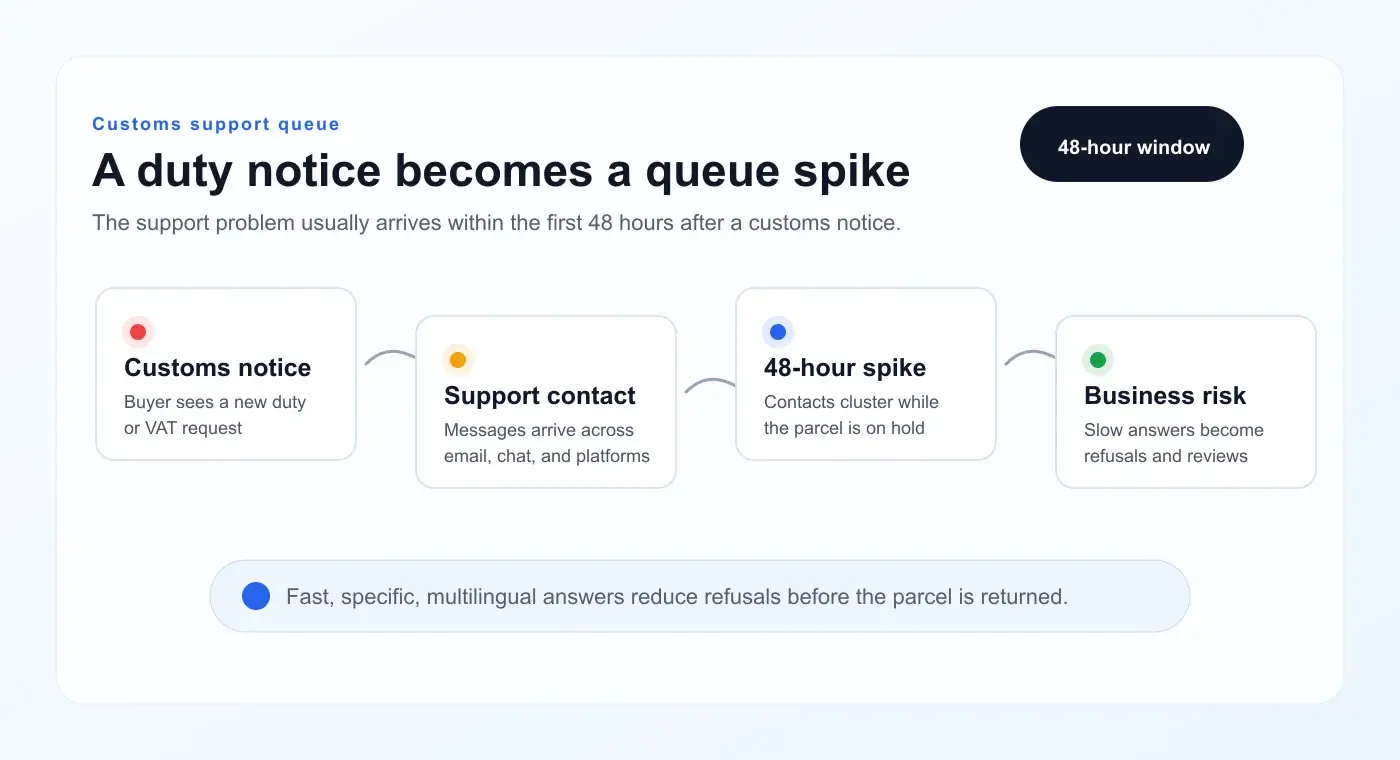
The hardest part is timing. Customs questions often cluster in the 48 hours after a parcel is held, released, or marked as requiring payment. If a batch of parcels clears together, the support spike arrives in a single afternoon.
Buyers in that state do not wait patiently. They open disputes, message on multiple channels, request refunds, refuse delivery, or leave reviews that frame the issue as a hidden-charge experience.
Why Customs Contacts Are Harder Than Shipping Tickets
Customs inquiries look like shipping tickets, but they behave differently. They arrive in the buyer’s language, at the buyer’s hour, and they need someone who can read a carrier’s duty notice — which is why they usually land on a multilingual support team rather than a general queue.
The buyer is emotional before the conversation starts. A tracking delay is annoying. A surprise charge feels personal. The buyer may believe the seller hid a fee, even when the charge is legitimate. If the first response is a cold policy explanation, the support team can make the situation worse.
The answer depends on live data. “Why do I owe this?” cannot be answered well with a generic template. The answer may depend on declared value, product category, HS code, origin country, destination country, VAT collection at checkout, carrier process, and local duty rules. A template that says “customs fees are the buyer’s responsibility” may be technically true and operationally useless.
The volume spikes suddenly. Customs contacts do not arrive evenly. They cluster around carrier notifications and parcel-hold deadlines. The team can be quiet at 10 a.m. and overloaded by 2 p.m.
The language mix expands quickly. EU and global shipping means the same question arrives in German, French, Spanish, Italian, Dutch, Polish, Portuguese, and more. “Do I have to pay this?” is simple in one language. At scale, it becomes a coverage problem.
The cost of delay is visible. The buyer may have a limited window to pay before the package is returned. A slow answer can directly become a refused delivery.
The Financial Footprint of a Bad Answer
One mishandled customs inquiry has a practical cost.
Imagine an $85 fashion or consumer electronics accessory order. The buyer receives a customs notice for $12 to $25 and contacts support. The team is overloaded, so the first reply comes late. When it arrives, it is generic and does not explain whether VAT was collected, why the charge exists, or what the buyer should do next.
The buyer refuses delivery.
Now the seller may absorb outbound shipping, return handling, refund processing, marketplace friction, and possible inventory recovery costs. Depending on product value and logistics route, one refusal can easily create a $30 to $60 loss. In low-margin categories, that can erase the order and part of the next one.
Then there is the review risk. A buyer who feels surprised by a charge and ignored by support rarely describes the experience in technical customs language. They write what future buyers understand immediately: “hidden fees,” “bad support,” “unexpected charge,” “would not buy again.”
That is why customs support should be measured against prevented refusals and protected reviews, not only ticket handling cost.
How HeroDash Handles the Customs Inquiry Surge
HeroDash is designed for high-volume, multilingual, emotionally sensitive support where the answer needs both speed and context.
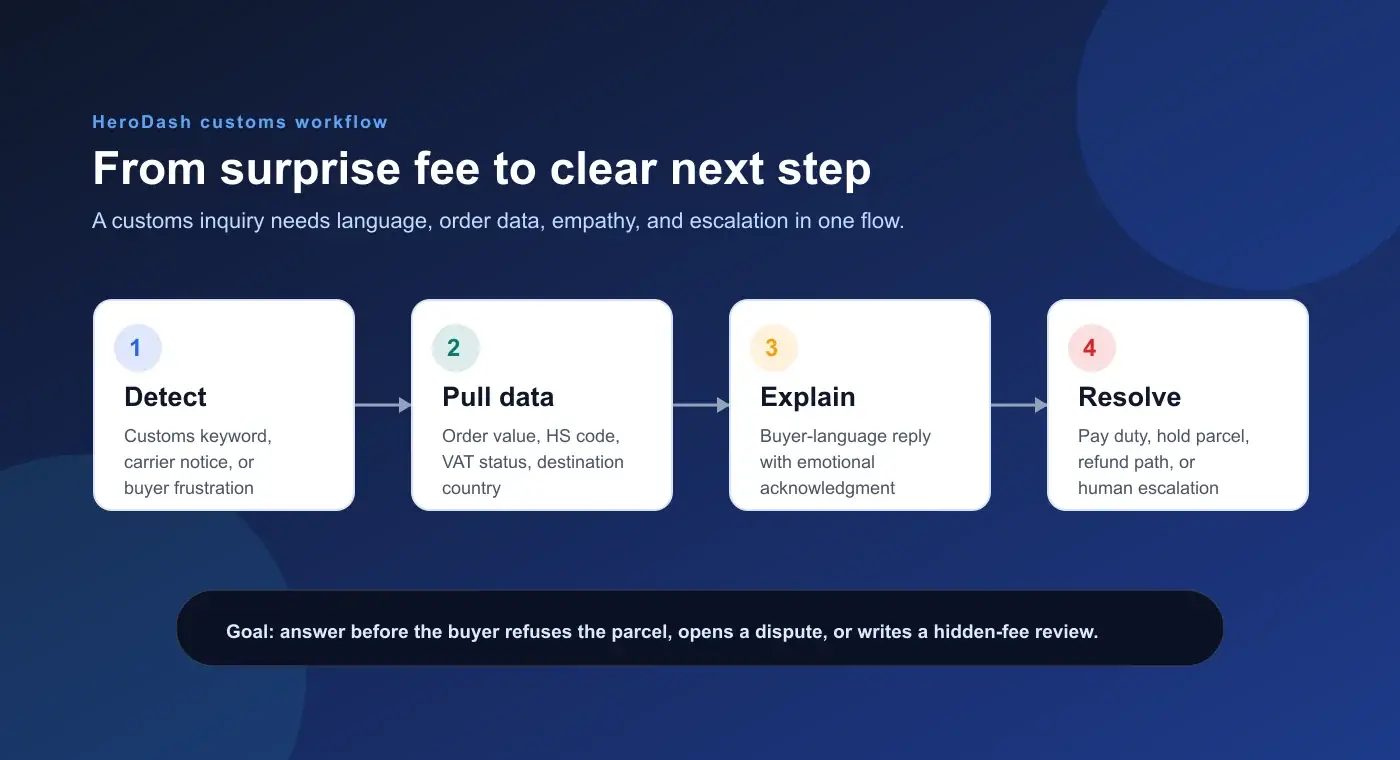
Immediate response in the buyer’s language. HeroDash supports 65+ languages. A French buyer can receive a French answer. A German buyer can receive a German answer. A Spanish buyer can receive a Spanish answer. The seller does not need to wait for the correct language agent to become available before the buyer receives a first useful response.
Order-data context for specific answers. When connected to order and logistics systems, HeroDash can pull the details that matter: order value, destination country, product category, HS-code context, tax status, carrier event, and payment status. This lets the response explain the buyer’s situation, not just the seller’s policy.
Emotional acknowledgment before policy explanation. The sequence matters. “I understand this was unexpected. Let me check your order and explain what this charge is connected to” creates a different interaction than “Customs fees are your responsibility.” The first response lowers tension. The second can inflame it.
Elastic capacity during spikes. If 200 customs questions arrive in three hours, HeroDash can absorb the spike without a traditional queue penalty: first responses, order checks, triage, and escalation routing happen immediately instead of waiting for every buyer to reach a human agent.
Escalation for disputes and sensitive cases. Most customs questions can be answered with data and clear explanation. But disputed duty calculations, threatened chargebacks, marketplace policy issues, high-value orders, and angry repeat contacts should move to trained human agents. HeroDash escalates those cases with context already attached.
All channels in one workspace. Customs questions arrive through email, marketplace messaging, live chat, WhatsApp, and social media. A single workspace reduces the chance that a buyer who messaged on one channel gets ignored while the team is watching another.
| Buyer question | Data needed | Best response | Escalate when |
|---|---|---|---|
| ”Why am I paying again?” | Checkout tax status, carrier notice, destination rule | Acknowledge the surprise, then explain what was collected at checkout and what is collected at delivery. | Buyer alleges hidden fees or threatens a dispute. |
| ”Do I have to pay this?” | Parcel hold status, payment deadline, return rule | Explain whether payment is required for delivery and what happens if the deadline passes. | Buyer refuses payment or package value is high. |
| ”Was VAT already included?” | VAT/IOSS status, order invoice, destination country | Confirm what was collected at checkout and why a carrier may still request duty or handling payment. | Tax data is missing or inconsistent. |
| ”Can you refund the customs fee?” | Seller policy, marketplace rules, margin threshold | State the policy clearly and offer the approved next step. | Buyer is a VIP, repeat buyer, or marketplace case. |
A Better Workflow for Customs Support
Detect the customs trigger
Identify carrier notices, customs keywords, duty questions, VAT confusion, payment-window language, and repeat messages from the same buyer.
Pull the order context
Bring in order value, destination country, product category, tax status, logistics milestone, and any checkout disclosure the buyer saw.
Answer in the buyer's language
Acknowledge the surprise first, then explain the charge using the buyer’s order details and a clear next step.
Escalate only the right cases
Route disputes, high-value orders, chargeback threats, and unclear duty calculations to trained agents with full context.
This workflow is worth evaluating if:
- you ship low-value parcels across borders;
- buyers are seeing duty or VAT notices after checkout;
- your support team is already receiving “why am I paying again?” messages;
- marketplace reviews mention hidden fees, taxes, or customs charges;
- your EU, US, UK, Canada, Australia, or Brazil queues require multiple languages;
- agents have to switch between order tools, carrier portals, and support channels to answer one customs question.
This Is Not a Temporary Spike
The direction is clear: cross-border ecommerce is moving toward more formal duty, tax, and data requirements for low-value parcels. If you are weighing whether to carry that load in-house or hand it to a partner, we wrote a fuller guide to ecommerce customer service outsourcing — including what the hourly rates actually cover.
That does not mean every buyer will understand the change. Most will not. From the buyer’s perspective, the experience is simple: they paid at checkout, then someone asked for more money.
Sellers who treat this as a temporary surge will rebuild the same response every time a market changes its rules. Sellers who build multilingual, order-aware, multichannel support infrastructure can absorb the next change with less disruption.
The practical question is not whether customs policy is changing. It already is.
The practical question is whether your support operation can plan for a 3x to 5x customs-inquiry scenario during customs-notice batches as a stress test, across multiple languages, inside a 48-hour parcel-hold window, without sending buyers into disputes, refusals, and bad reviews.
If the honest answer is no, the time to fix that is before the next batch of customs notices lands.
FAQ
Why do customs bills create so many support tickets?
Unexpected customs bills create support tickets because buyers feel surprised, misled, or unsure whether the charge is legitimate. They usually contact the seller first because the seller owns the customer relationship, even when the fee is charged by customs or a carrier.
What should ecommerce support teams include in a customs inquiry workflow?
A strong customs workflow needs buyer-language response, order data, product and HS-code context, VAT or duty status, channel visibility, escalation rules, and fast coverage during 48-hour parcel-hold windows.
How can HeroDash help with customs inquiry spikes?
HeroDash helps by responding across 65+ languages, connecting to order data, explaining customs charges with context, handling multichannel spikes, and escalating disputed or sensitive cases to human agents with full background.
Prepare your customs inquiry workflow before the next parcel-hold spike. Explore HeroDash for multilingual ecommerce support, or learn how Callnovo supports ecommerce operations across markets and channels.
Sources: U.S. Customs and Border Protection fact sheet on suspending duty-free de minimis treatment; Council of the EU final approval for new customs duty rules on small parcels; European Commission update on removing the EUR 150 customs duty relief threshold.